Harvard Engineers Build Chip That Twists Light in Real Time
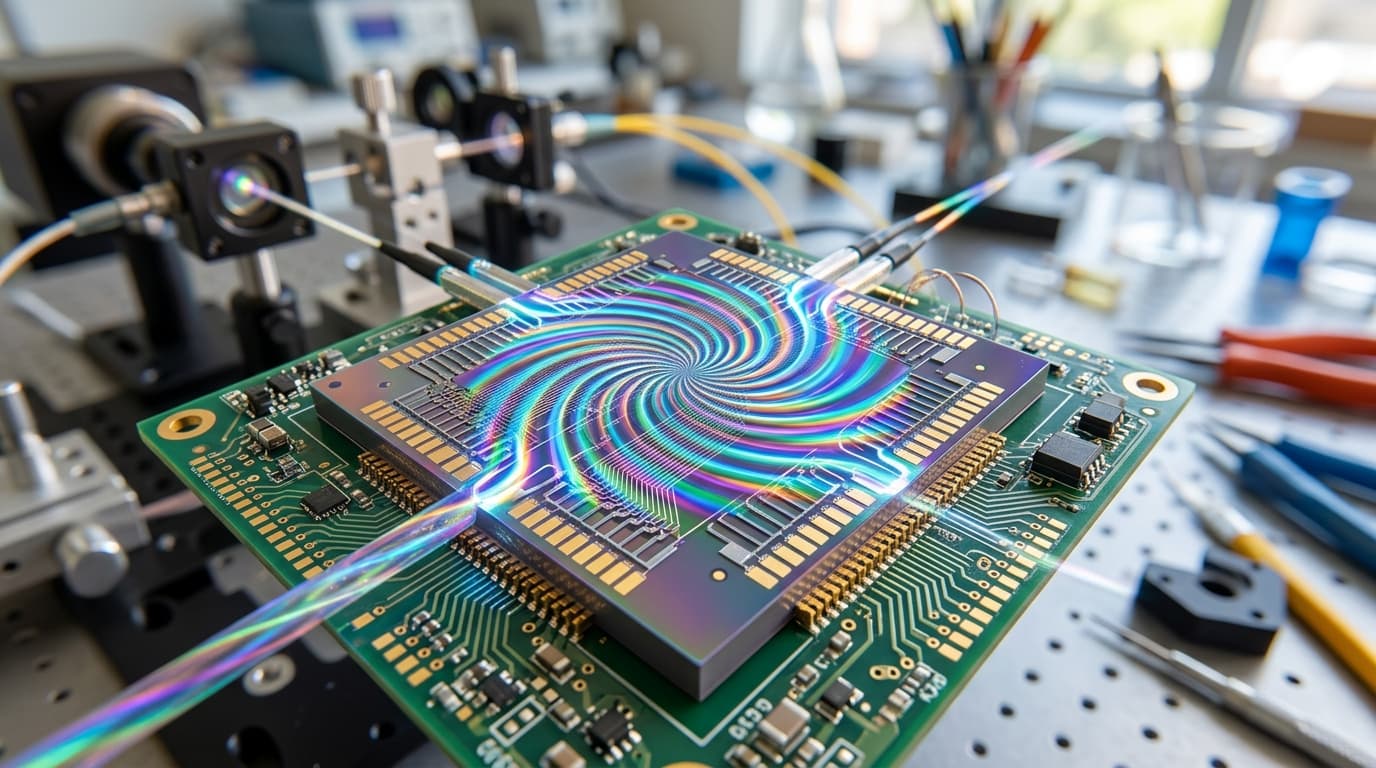
Harvard engineers have developed a groundbreaking photonic chip that can twist and control light's polarization in real time, potentially revolutionizing sensors, communications, and quantum computing.

Harvard Engineers Build Chip That Twists Light in Real Time
Learn more about some things just take time: tech innovation patience
Light carries information in ways most of us never consider. Beyond brightness and color, light possesses a property called polarization, which describes how its electromagnetic waves oscillate through space.
Scientists at Harvard's John A. Paulson School of Engineering and Applied Sciences have created a miniature device that can twist and tune this polarization in real time. This breakthrough opens unprecedented possibilities for sensing, communication, and quantum computing.
The chip uses stacked photonic crystals and a tiny mechanical system to control light's "handedness" with remarkable precision. This represents a significant leap forward in our ability to manipulate light at the nanoscale, potentially transforming technologies from medical diagnostics to secure communications.
What Makes This Photonic Crystal Chip Revolutionary?
The Harvard team's device operates on a principle that sounds simple but requires extraordinary engineering precision. Two photonic crystals sit stacked on top of each other, and researchers can rotate them relative to one another while adjusting their spacing. This mechanical manipulation changes how light behaves as it passes through the structure.
Photonic crystals are materials engineered with periodic nanostructures that affect light propagation. Think of them as optical obstacle courses where the spacing between barriers determines which wavelengths can pass through and how they emerge on the other side.
By dynamically adjusting these crystals, the Harvard chip distinguishes between left-circular and right-circular polarized light with exceptional accuracy. The device measures just millimeters across, yet it achieves control that previously required bulky laboratory equipment.
This miniaturization makes the technology practical for real-world applications rather than confining it to research labs.
How Does Light's Handedness Work?
Circular polarization describes light waves that rotate as they travel through space. Left-circular polarized light spirals counterclockwise, while right-circular polarized light spirals clockwise when viewed head-on.
For a deep dive on airpods max 2, ios 26.4 rc, and top apple stories, see our full guide
Many natural and synthetic materials interact differently with these two forms, a property called optical chirality. Molecules in living organisms often exhibit handedness themselves.
DNA twists in a right-handed helix. Many biological molecules exist in mirror-image forms that behave identically in most circumstances but interact differently with circularly polarized light. This makes chirality detection crucial for pharmaceutical development, where a drug's mirror image might be ineffective or even harmful.
For a deep dive on mamba-3: the next evolution in state space models, see our full guide
The Harvard chip actively switches between detecting and manipulating different polarization states. Previous devices could measure circular polarization, but they lacked the ability to tune their response in real time.
What Are the Real-World Applications?
The potential applications for this technology span multiple fields, each leveraging the chip's unique capabilities.
Medical and Pharmaceutical Sensing
- Rapid detection of molecular handedness in drug compounds
- Real-time monitoring of biological processes that involve chiral molecules
- Improved diagnostic tools for detecting diseases through molecular signatures
- Quality control in pharmaceutical manufacturing
Advanced Communications
- Higher data transmission rates using polarization as an additional information channel
- More secure optical communication systems resistant to eavesdropping
- Reduced signal interference in crowded communication networks
Quantum Computing and Cryptography
- Better control of quantum states encoded in photon polarization
- Enhanced quantum key distribution for unbreakable encryption
- Improved quantum sensors with unprecedented sensitivity
How Did Engineers Build This Device?
Building a device that mechanically adjusts photonic crystals at the nanoscale while maintaining optical precision presents formidable challenges. The Harvard team integrated microelectromechanical systems (MEMS) technology with advanced photonic structures.
MEMS devices use microscopic mechanical components, similar to those in smartphone accelerometers, but adapted for optical applications. The rotation mechanism operates with nanometer precision while remaining stable enough for repeated use.
Temperature fluctuations, vibrations, and material stress all threaten to disrupt the delicate alignment between crystal layers. The researchers developed specialized materials and control systems to maintain stability under varying conditions.
Each photonic crystal contains patterns etched at scales smaller than the wavelength of visible light. Manufacturing these structures requires advanced lithography techniques borrowed from semiconductor fabrication. The team optimized the crystal geometry to maximize the difference in how left and right polarized light interact with the device.
Why Does Real-Time Control Matter?
Static optical devices have served science well for decades, but they lack adaptability. A conventional polarization filter works for one specific configuration, requiring physical replacement to change its properties.
The Harvard chip eliminates this limitation through dynamic reconfiguration. Real-time control enables responsive systems that adjust to changing conditions.
A sensor could scan through different polarization states to identify unknown molecules. A communication system could switch encoding schemes based on channel conditions. A quantum computer could dynamically optimize qubit control for different computational tasks.
The chip changes its configuration in microseconds, fast enough for many practical applications while slow enough to maintain precise control. This balance between speed and precision defines the device's practical utility.
What Challenges Remain Before Commercialization?
Despite its promise, the technology faces several hurdles before widespread adoption. Manufacturing complexity tops the list.
Each chip requires precise fabrication of nanoscale features and integration with mechanical control systems. Scaling production while maintaining quality will require significant development.
Power consumption presents another consideration. The mechanical actuation systems need energy, and minimizing this requirement will prove crucial for battery-powered applications. The research team continues optimizing the design to reduce power demands without sacrificing performance.
Integration with existing optical systems also requires attention. The chip must interface with standard fiber optics, light sources, and detectors.
How Does This Compare to Previous Approaches?
Earlier attempts to control circular polarization relied on different strategies. Liquid crystal devices can rotate polarization but struggle with circular states and lack the precision needed for quantum applications.
Metamaterials showed promise but proved difficult to tune dynamically. Mechanical rotation of traditional optical elements works but remains too slow and bulky for integrated systems.
The Harvard approach combines the best aspects of these methods while avoiding their limitations. The photonic crystal design provides strong interaction with circular polarization. The mechanical tuning enables real-time adjustment. The compact form factor allows integration into larger systems.
What Is the Broader Impact on Photonics Research?
This development represents more than a single device. It demonstrates that complex optical functions previously requiring laboratory-scale equipment can fit onto chips smaller than a fingernail.
This miniaturization trend mirrors the revolution that integrated circuits brought to electronics. The techniques developed for this chip will likely inspire related innovations.
Researchers can adapt the stacked photonic crystal approach to control other light properties beyond polarization. The integration of mechanical and optical systems at small scales opens new design possibilities across photonics.
As fabrication techniques improve and costs decrease, dynamically tunable photonic chips may become as ubiquitous as electronic microprocessors. This would enable optical computing, ultra-sensitive environmental monitoring, and communication systems we can barely imagine today.
The Future of Light Manipulation Technology
The Harvard team's photonic crystal chip marks a significant milestone in our ability to control light at the nanoscale. By enabling real-time manipulation of circular polarization, the device opens pathways to smarter sensors, faster communications, and more capable quantum technologies.
While challenges remain before commercialization, the fundamental breakthrough demonstrates that sophisticated optical control can fit in remarkably small packages. As researchers refine the technology and explore new applications, we may soon see these chips in medical diagnostic tools, secure communication networks, and next-generation quantum computers.
Continue learning: Next, explore elon musk found guilty of defrauding twitter investors
The ability to twist and tune light with such precision transforms what seemed like a fundamental limitation into a powerful tool for innovation.
Related Articles

Quantum Leap: Room Temp Superconductors Unveiled
Discover the groundbreaking world of room temperature superconductors and their potential to revolutionize quantum computing and technology.
Sep 6, 2025

iPhone 17 Unveiled: Features & Expectations
With the iPhone 17 launch just a week away, explore the rumored features, technological advancements, and Apple's push for sustainability.
Sep 5, 2025

Atlassian's Strategic Move: Acquiring The Browser Company
Atlassian's acquisition of The Browser Company marks a significant shift towards integrated, innovative digital workspaces and team collaboration tools.
Sep 4, 2025