Ghostling: The AI Tool Transforming Digital Communication
Ghostling AI technology helps professionals manage communication overload by learning individual writing styles and generating personalized messages that maintain authentic human connection.

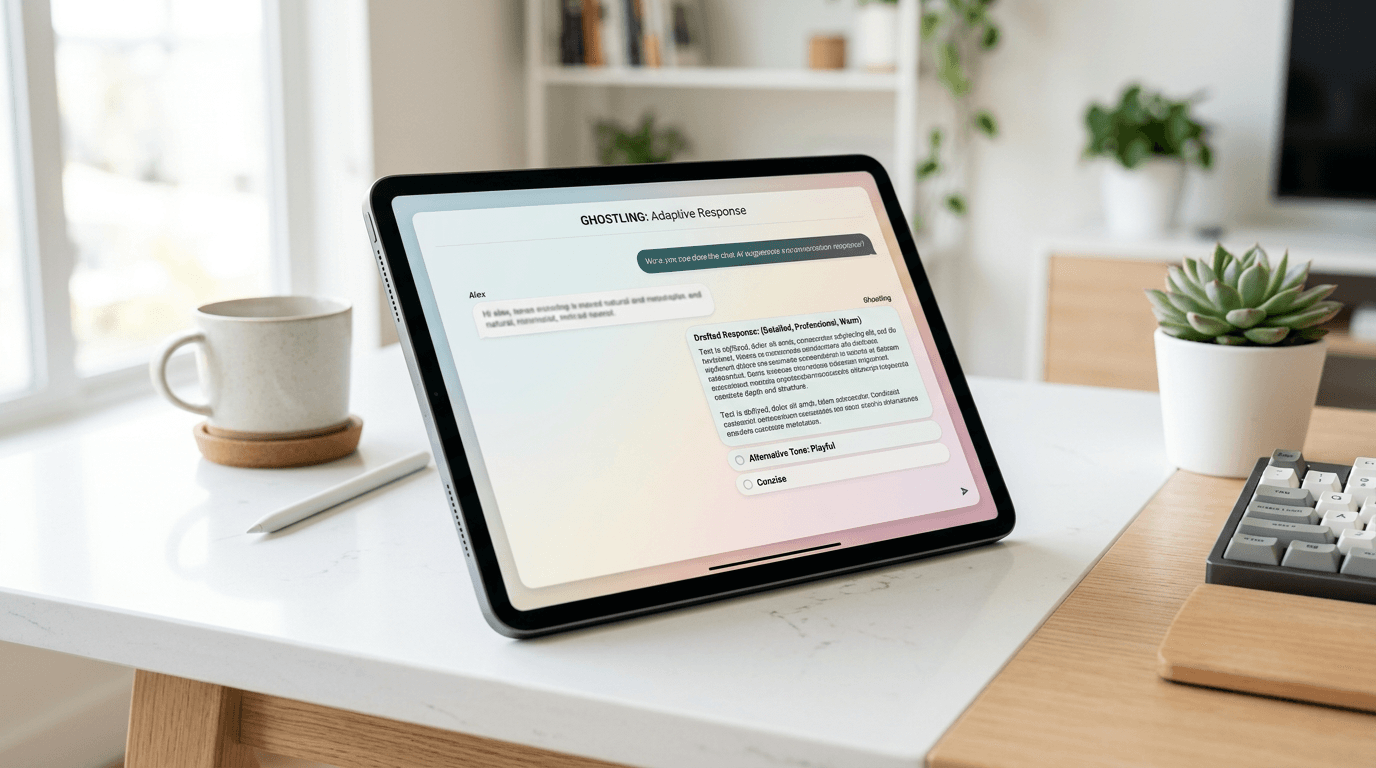
Digital Communication Faces a Growing Challenge: Can AI Help Maintain Authentic Human Connection?
Learn more about three ways ai is learning to understand the physical world
Digital communication faces a growing challenge: maintaining authentic human connection while managing increasing message volumes. Ghostling emerges as an innovative AI-powered solution that addresses this tension, offering users a way to streamline their communication without sacrificing personal touch.
This technology represents a significant shift in how we approach written correspondence, particularly for professionals juggling multiple conversations across platforms. The tool leverages advanced language models to assist with drafting, refining, and personalizing messages at scale.
What Is Ghostling and How Does It Work?
Ghostling refers to AI-powered writing assistance tools that help users compose messages, emails, and responses by learning their communication style. These platforms analyze your previous writing patterns, tone preferences, and vocabulary choices to generate content that sounds authentically like you.
The technology operates through machine learning algorithms trained on natural language processing. When you need to respond to an email or craft a message, Ghostling provides suggestions or complete drafts based on context and your established voice. Unlike generic AI writing tools, these systems prioritize personalization.
They adapt to individual communication styles rather than producing one-size-fits-all content.
How Does the Technology Behind Ghostling Tools Work?
Most ghostling applications utilize transformer-based language models similar to GPT architectures. These neural networks process text by understanding relationships between words, phrases, and contextual meaning across entire documents.
The training process involves analyzing thousands of your previous messages to identify patterns. The AI learns your preferred greeting and closing styles, common phrases and expressions, sentence structure preferences, formality levels for different contexts, and response length tendencies.
This personalization layer distinguishes ghostling from standard AI writing assistants. The technology creates a digital communication fingerprint unique to each user.
Why Are Professionals Adopting Ghostling Solutions?
For a deep dive on how puppeteer james ortiz brought rocky to life in projec..., see our full guide
Time constraints drive the primary adoption of these tools. Research indicates professionals spend an average of 28% of their workweek managing email correspondence alone. Ghostling technology can reduce this time investment by 40-60% while maintaining communication quality.
Executives, entrepreneurs, and customer service teams particularly benefit from this efficiency gain. They handle high message volumes that demand personalized responses rather than generic templates. The mental load reduction proves equally valuable.
For a deep dive on leadership skills for constant change: internal mastery, see our full guide
Decision fatigue from crafting dozens of daily messages decreases when AI handles initial drafts. Users review and refine rather than starting from blank screens.
Which User Groups Benefit Most From Ghostling?
Business leaders use ghostling to maintain consistent communication with stakeholders while focusing on strategic priorities. The technology ensures no message goes unanswered due to time constraints.
Content creators leverage these tools to engage with their audience at scale. Responding to comments, messages, and collaboration requests becomes manageable without sacrificing authenticity.
Customer service departments deploy ghostling to handle routine inquiries efficiently. The AI maintains brand voice consistency across team members while accelerating response times.
How Does Ghostling Differ From Standard AI Writing Tools?
The distinction lies in personalization depth and intended use case. Standard AI writing assistants like ChatGPT or Claude provide general-purpose content generation. They produce quality writing but lack individual voice characteristics.
Ghostling platforms specifically train on your communication history. They replicate your unique style rather than generating generic professional prose. This specificity makes output feel genuinely personal rather than AI-generated.
Integration depth also separates these tools. Many ghostling solutions embed directly into email clients, messaging platforms, and CRM systems. This native integration streamlines workflow more effectively than standalone writing tools.
What Privacy and Data Security Considerations Should You Know?
Ghostling technology requires access to your communication history, raising legitimate privacy concerns. Reputable platforms implement end-to-end encryption and local processing options to protect sensitive information.
Users should evaluate several security factors before adoption. Consider data storage locations and encryption standards, third-party access policies and data sharing practices, compliance with GDPR, CCPA, and industry-specific regulations, and user control over training data and model deletion options.
Some advanced ghostling tools offer on-premise deployment for organizations with strict data governance requirements. These solutions keep all training data and processing within company infrastructure.
How Can You Implement Ghostling in Your Workflow?
Successful adoption requires strategic implementation rather than wholesale replacement of manual communication. The technology works best as an augmentation tool that handles routine correspondence while you focus on complex, sensitive conversations.
Start with low-stakes communications like meeting confirmations, acknowledgment messages, or routine follow-ups. This approach lets you evaluate output quality and build trust in the system before expanding usage. Establish clear review protocols.
Even highly personalized AI can miss contextual nuances or make inappropriate suggestions. Human oversight remains essential, particularly for important stakeholder communications.
What Are the Best Practices for Effective Ghostling Use?
Provide the AI with diverse training data spanning different contexts and recipients. This variety improves adaptability across communication scenarios.
Regularly update your training dataset with recent messages. Communication styles evolve, and your ghostling tool should reflect current preferences rather than outdated patterns. Create usage guidelines for team implementations.
Define which message types warrant AI assistance versus full manual composition. This clarity prevents over-reliance while maximizing efficiency gains.
Monitor output quality through periodic audits. Review AI-generated messages to ensure they maintain your standards and accurately represent your voice.
What Are the Limitations and Ethical Considerations?
Ghostling technology cannot fully replicate human judgment, emotional intelligence, or contextual awareness. Complex negotiations, sensitive HR matters, and crisis communications require human composition despite time pressures.
Transparency presents an ethical question: should recipients know they're reading AI-assisted messages? Opinions vary, but many communication experts recommend disclosure for significant business correspondence. The technology risks creating communication bubbles where similar AI-generated styles dominate professional exchanges.
This homogenization could reduce the authentic diversity that enriches human interaction.
How Can You Avoid Over-Reliance on AI Communication?
Maintain direct composition skills through regular practice. Reserve certain communication types for manual writing to preserve your natural ability.
Recognize situations where AI assistance proves inappropriate. Condolences, apologies, highly personal messages, and strategic negotiations benefit from fully human composition. Balance efficiency with authenticity.
The goal involves managing communication volume effectively while preserving genuine human connection in your professional relationships.
What Does the Future Hold for Ghostling Technology?
Development trajectories point toward increasingly sophisticated personalization. Next-generation tools will incorporate emotional intelligence, reading recipient sentiment and adjusting tone accordingly.
Multimodal capabilities will expand beyond text to include voice message drafting and video script preparation. These advances will extend ghostling benefits across all digital communication channels. Integration with productivity ecosystems will deepen.
Future platforms may automatically draft responses based on calendar context, project status, and relationship history without explicit user prompts.
Real-time collaboration features will enable teams to maintain consistent communication voices across departments. This capability proves particularly valuable for organizations prioritizing brand consistency.
Conclusion: Is Ghostling Right for Your Communication Needs?
Ghostling represents a pragmatic approach to managing modern communication demands without sacrificing personal authenticity. The technology offers significant time savings and mental load reduction for professionals handling high message volumes.
Successful implementation requires thoughtful integration, strong privacy protections, and appropriate boundaries around usage. When deployed strategically, these tools enhance rather than replace human communication capabilities.
Continue learning: Next, explore japanese chopsticks faux pas: a digital etiquette guide
As AI writing assistance continues evolving, ghostling platforms will likely become standard productivity tools alongside email clients and project management software. The key lies in leveraging these capabilities while maintaining the genuine human connection that makes communication meaningful.
Related Articles

AI's Role in Unveiling ICE Officers' Identities
AI unmasking ICE officers underscores a shift towards transparent law enforcement, raising questions about privacy and ethics in the digital age.
Sep 2, 2025

AI's Role in Unveiling ICE Officers' Identities
AI's application in unveiling ICE officers' identities sparks debate over privacy and accountability, highlighting a new era in technology.
Sep 2, 2025

AI Tools Reveal Identities of ICE Officers Online
AI's emerging role in unmasking ICE officers spotlights the intersection of technology, privacy, and ethics, sparking a crucial societal debate.
Sep 2, 2025