Fors FMS Turns Game Boy Advance into FM Groovebox for $10
A $10 cartridge called Fors FMS transforms the Game Boy Advance into a legitimate FM synthesis groovebox with professional features that rival modern hardware synths.

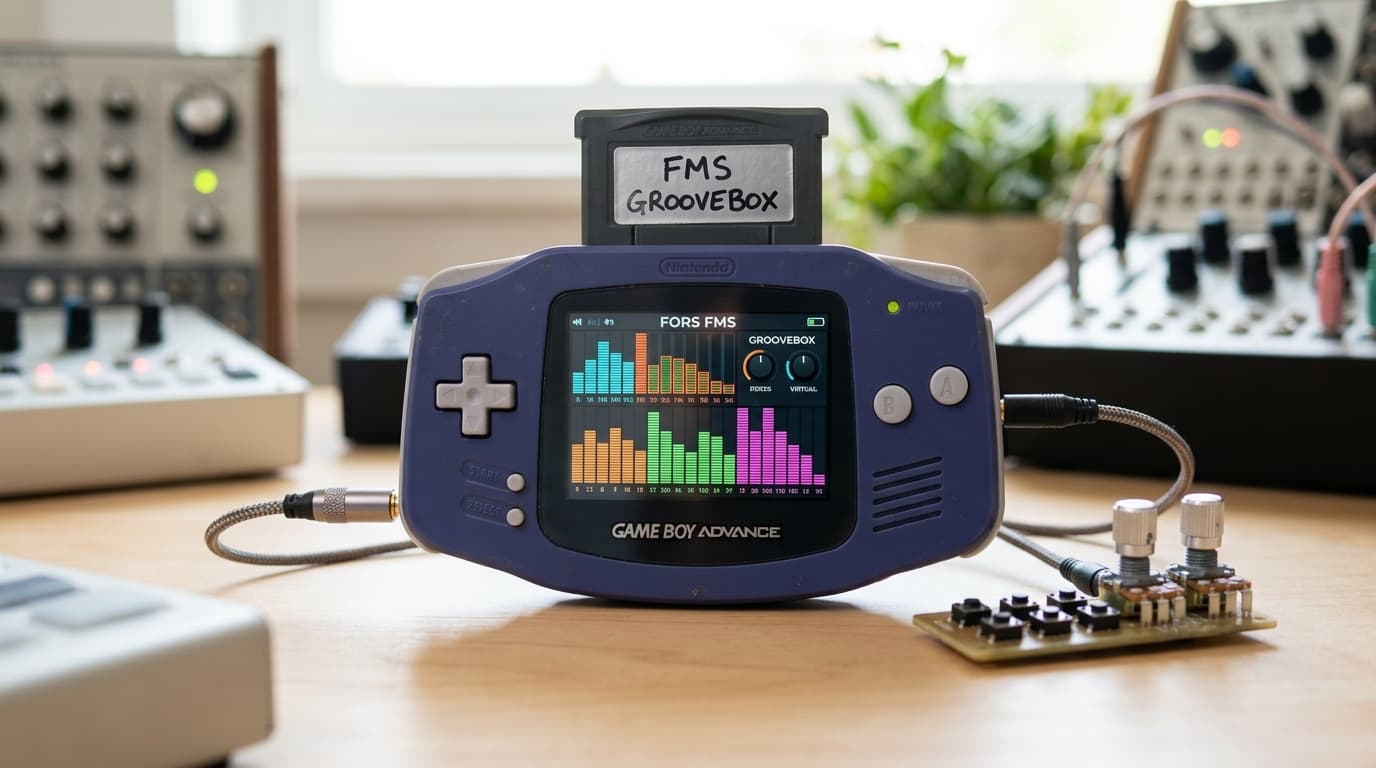
Fors FMS Turns the Game Boy Advance into an FM Groovebox
Learn more about expert sleepers ntx-8cv & forever eurorack modules review
The Game Boy Advance just became a serious music production tool. Fors FMS, a new $10 software cartridge available on itch.io, transforms Nintendo's handheld console into a fully functional 2-operator FM synthesis groovebox complete with a pattern-based sequencer. This is not just another chiptune novelty.
It's a legitimate production instrument that brings Elektron-style workflow features to a device that's over two decades old. The combination of authentic FM synthesis, built-in sequencing, and sync capabilities delivers professional-grade features at a fraction of what you'd pay for dedicated hardware.
How Does Fors FMS Differ from Other Game Boy Music Software?
Fors FMS stands apart from the crowded field of Game Boy music applications through its focus on FM synthesis rather than the typical pulse wave and noise channels. The software implements a 2-operator FM engine that generates complex, evolving timbres far beyond what most handheld music tools offer.
The interface draws clear inspiration from modern grooveboxes, particularly Elektron's workflow philosophy. You get parameter locks, pattern chaining, and real-time performance controls that feel familiar to anyone who's used professional hardware sequencers.
Unlike LSDJ or Nanoloop, which focus on traditional Game Boy sound chip manipulation, Fors FMS creates its sounds entirely through software-based FM synthesis. This approach opens up sonic possibilities that simply were not available on the Game Boy Advance before.
Can You Really Do FM Synthesis on a Handheld Console?
Two-operator FM synthesis might sound limiting compared to the six operators found in classic Yamaha synths, but the format proves surprisingly versatile. You can create everything from punchy bass lines and metallic percussion to bell-like tones and evolving pads.
The Game Boy Advance's ARM7 processor handles the FM calculations efficiently, maintaining stable performance even with multiple voices playing simultaneously. The audio output quality exceeds expectations, delivering clean signals through both the headphone jack and link cable audio modifications.
What Key Features Does Fors FMS Offer for Music Production?
Fors FMS packs an impressive feature set into its compact package:
- Pattern-based sequencer with up to 16 steps per pattern and multiple pattern chains
- Parameter locks for per-step automation of synthesis parameters
- MIDI sync support via link cable adapters for integration with other gear
- Real-time performance controls for live tweaking and sound design
- Save and load functionality to preserve your projects and sound banks
- Multiple voice polyphony for creating full arrangements
For a deep dive on maintainer month: celebrating open source contributors, see our full guide
The sequencer operates smoothly with tight timing that rivals dedicated hardware. You can program complex rhythmic patterns, automate filter sweeps, and create evolving sequences that maintain perfect sync with external devices.
Does the Sequencer Match Modern Groovebox Standards?
For a deep dive on cyma forma rnd: random hardware synth revolution, see our full guide
The pattern-based workflow will feel immediately familiar to anyone who's used an Elektron Digitakt, Novation Circuit, or similar modern groovebox. You select a pattern, enter step mode, and place notes across the 16-step grid. Simple.
Parameter locks function exactly as you'd expect. Hold a step and adjust any synthesis parameter to create per-step variations in sound.
This feature alone elevates Fors FMS from simple novelty to genuine production tool, enabling complex sound design that evolves throughout your patterns. Pattern chaining allows you to build complete song structures without external sequencing.
How Do You Set Up Your Game Boy Advance Studio?
Getting started with Fors FMS requires minimal investment beyond the $10 software purchase. You'll need a Game Boy Advance or Game Boy Advance SP console, which typically sells for $40-80 on the used market.
A flash cartridge like the EZ-Flash Omega or Everdrive GBA ($60-100) lets you load the software onto physical hardware. The audio output quality improves significantly with a prosound modification or clean amplification.
The standard headphone jack works fine for sketching ideas, but serious production benefits from either a line-level modification or a high-quality headphone amplifier. For sync capabilities, you'll want a link cable MIDI adapter.
What's the Best Recording and Integration Workflow?
Recording Fors FMS into your DAW follows the same process as any external synthesizer. Connect the Game Boy Advance's audio output to your audio interface, set appropriate gain levels, and record to a mono or stereo track.
The MIDI sync keeps everything locked to your project tempo. Start your DAW's transport, and Fors FMS follows along perfectly.
This integration means you can use the Game Boy as another voice in your productions alongside software instruments and other hardware. Many producers record multiple passes with different parameter lock settings, then layer and process the results.
What Sound Design Possibilities Does 2-Op FM Offer?
Two-operator FM synthesis offers more creative range than you might expect. The relationship between carrier and modulator frequencies determines the harmonic content, while modulation depth controls the brightness and complexity.
Percussive sounds come naturally to FM synthesis. Adjust the envelope to create snappy kicks, crisp snares, and metallic hi-hats that cut through dense mixes.
Bass sounds benefit from the fundamental strength of FM operators. Program simple ratios for clean sub-bass, or increase modulation for aggressive, distorted tones. The Game Boy's audio circuitry adds subtle character that enhances low-end presence.
Lead and pad sounds emerge when you explore harmonic and inharmonic ratios. Bell-like tones, electric piano textures, and evolving soundscapes all live within the 2-operator framework.
How Do You Create Custom Sound Banks?
Fors FMS allows you to save custom patches and recall them during performances or production sessions. Building a personal sound library transforms the device into a go-to instrument for specific sonic signatures.
Experiment with operator ratios systematically to discover sweet spots. Document your findings and organize patches by category: bass, leads, percussion, textures.
This organized approach speeds up your workflow when inspiration strikes. The parameter lock system means individual patches serve as starting points rather than fixed sounds.
Why Does Fors FMS Matter for Modern Producers?
Fors FMS represents a broader trend toward affordable, portable music production tools. The $10 price point removes financial barriers while the Game Boy platform offers genuine portability and battery-powered operation.
The constraints of 2-operator FM synthesis force creative problem-solving. Working within limitations often produces more distinctive results than unlimited options.
The sonic character that emerges from these constraints gives your productions a unique fingerprint. Portability enables music creation anywhere: sketch ideas during commutes, develop patterns while traveling, or perform live with minimal gear.
Does the Nostalgia Factor Add Production Value?
Game Boy aesthetics carry cultural weight that resonates with audiences. Using retro hardware connects your music to shared memories and gaming culture while maintaining sonic legitimacy through capable synthesis and sequencing.
The visual element of performing with a Game Boy Advance adds stage presence to live shows. Audiences engage differently when they see familiar devices creating unexpected sounds. This recognition factor enhances performance impact beyond pure audio considerations.
How Can You Maximize Your $10 Investment?
Maximizing Fors FMS requires hands-on experimentation. Spend time with each synthesis parameter to understand how it shapes your sound. The direct, tactile interface rewards exploration and builds intuitive understanding.
Integrate the Game Boy into your existing setup rather than treating it as a standalone instrument. Layer its sounds with software synths, process the output through effects chains, and use it as a melodic or rhythmic element within larger arrangements.
Connect with the chip music community for tips, patches, and inspiration. Online forums and Discord servers dedicated to Game Boy music production offer valuable resources and collaborative opportunities. Document your favorite settings and techniques.
What Are the Technical Specifications and Limitations?
Understanding Fors FMS's technical boundaries helps set realistic expectations. The Game Boy Advance's audio hardware outputs at approximately 32kHz sample rate with limited bit depth.
This specification creates characteristic lo-fi warmth but will not match modern high-resolution audio standards. Polyphony depends on CPU load and pattern complexity.
Simpler patches allow more simultaneous voices, while complex modulation routing reduces available polyphony. The screen size limits interface complexity compared to modern touchscreen devices.
Battery life varies by console model and battery condition. The Game Boy Advance SP's rechargeable battery typically provides 6-8 hours of continuous use, while the original Game Boy Advance runs longer on AA batteries.
Is Fors FMS Worth Adding to Your Production Setup?
Fors FMS delivers remarkable value at its $10 price point, transforming the Game Boy Advance into a capable FM synthesis groovebox with professional workflow features. The combination of 2-operator FM synthesis, pattern-based sequencing, parameter locks, and sync capabilities creates a legitimate production tool that punches far above its weight class.
For producers seeking affordable hardware expansion, portable sketching tools, or distinctive sonic character, this software represents an obvious choice. The minimal financial risk makes experimentation easy, while the depth of features ensures long-term creative potential.
Continue learning: Next, explore .de tld offline: dnssec outage shakes german domain trust
Whether you're a chip music enthusiast or a professional producer looking for unique textures, Fors FMS deserves a place in your creative toolkit. At just $10, you gain access to a fully functional FM groovebox that fits in your pocket and integrates seamlessly with modern production workflows.
Related Articles

Transforming Gaza: From Conflict Zone to Tech Hub
A leaked plan from the Trump administration reveals a bold strategy to turn Gaza into a thriving high-tech hub. Discover the potential.
Sep 3, 2025

Gaza's Tech Revolution: Trump's Bold High-Tech Vision
A leaked plan from the Trump administration unveils a vision to make Gaza a high-tech hub, focusing on AI, cybersecurity, and digital innovation.
Sep 3, 2025

Trump's Bold Move: Patent Ownership for University Funding
Trump's administration proposes a bold initiative: patents for new inventions in exchange for university funding. How could this reshape technology?
Sep 2, 2025