Female Giant Rainforest Mantises Strike Harder Than Males
Scientists discovered female giant rainforest mantises develop strikes far more powerful than males. The evolutionary reason for this dramatic difference remains a mystery.

Predatory Insects Reveal Their Secrets Slowly
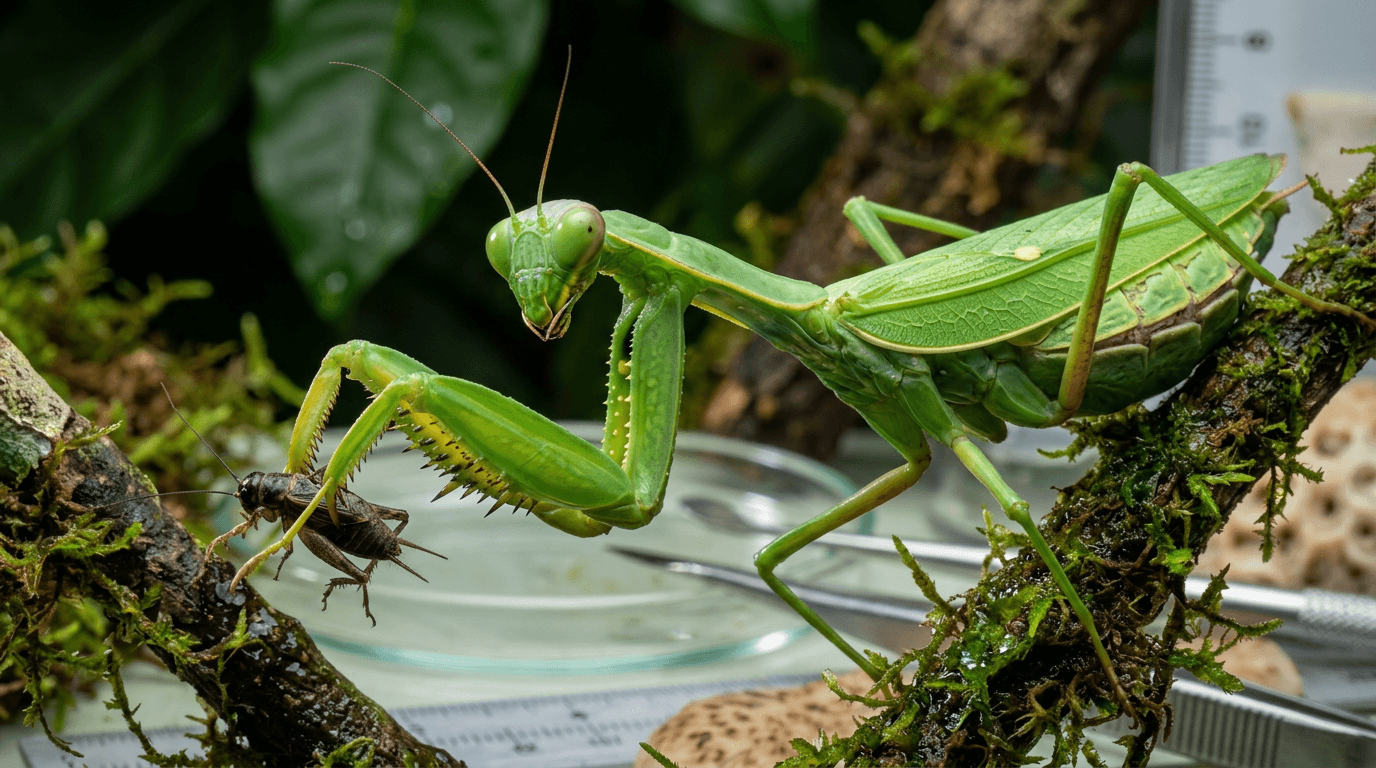
Scientists studying giant rainforest mantises discovered something unexpected: females grow up to strike with significantly more force than their male counterparts. This sexual dimorphism in striking power challenges assumptions about insect predation. It raises fascinating questions about evolutionary advantages in the rainforest canopy.
Why Do Female Giant Rainforest Mantises Strike Harder Than Males?
Researchers tracked the strike force of giant rainforest mantises from their juvenile stages through adulthood. The study revealed a striking pattern: while young mantises of both sexes hit with similar force, females eventually develop the ability to deliver far more powerful strikes than males.
This difference becomes pronounced as the insects mature. The divergence creates a clear divide in hunting capabilities between the sexes.
The research team measured strike velocity, acceleration, and impact force across multiple developmental stages. They found that female mantises can generate strikes with up to 2.5 times more force than males of the same age. This substantial difference suggests evolutionary pressures shaped each sex differently, though scientists remain puzzled about the exact reasons.
How Do Scientists Measure Mantis Strike Force?
Tracking the striking power of a lightning-fast predator requires specialized equipment and careful methodology. Researchers used high-speed cameras capable of capturing thousands of frames per second to document each strike. They combined this visual data with force sensors that measured the exact impact when mantises attacked prey.
The study followed individual mantises from their early instars through adulthood. This longitudinal approach provided crucial insights into how striking power develops over time.
Scientists could pinpoint exactly when the sexual dimorphism in strike force began to emerge. They tracked how rapidly it progressed through each developmental stage.
Key measurements included:
- Strike velocity and acceleration rates
- Impact force measured in millinewtons
- Raptorial foreleg mass and structure
- Prey capture success rates
- Energy expenditure during strikes
What Evolutionary Advantages Explain Female Striking Power?
The mystery deepens when considering potential evolutionary explanations. Female giant rainforest mantises grow larger than males, which partially explains their greater striking power. However, the force difference exceeds what size alone would predict.
One hypothesis centers on reproductive demands. Female mantises require substantial energy reserves to produce eggs. Hitting harder might allow them to capture larger, more nutritious prey with greater efficiency, providing the caloric intake needed for successful reproduction.
Another theory focuses on territorial behavior and competition. Larger females with more powerful strikes could dominate prime hunting territories. They might also use their superior force to defend egg cases from predators or competitors, translating into higher reproductive success over generations.
What Biomechanics Power Mantis Strikes?
Mantis strikes rank among the fastest movements in the animal kingdom. The insects use specialized raptorial forelegs that fold like jackknives and snap forward in milliseconds. This rapid deployment requires precise coordination between muscles, exoskeleton structure, and neural timing.
Female mantises develop more robust foreleg structures as they mature. Their raptorial legs show increased muscle mass and thicker cuticle in key stress points. These anatomical differences provide the structural foundation for delivering more forceful strikes without risking injury to their own limbs.
The energy storage mechanism also differs between sexes. Females appear to store more elastic energy in their foreleg joints before releasing it during strikes. This spring-loaded system amplifies muscle power, converting stored potential energy into devastating kinetic force in microseconds.
What Does This Research Reveal About Sexual Dimorphism in Insects?
Sexual dimorphism extends far beyond size differences in the insect world. This mantis research demonstrates how males and females of the same species can develop dramatically different capabilities.
Insect sexual dimorphism typically follows predictable patterns related to reproduction. Males often develop elaborate ornaments or fighting structures for mate competition. Females usually invest in size and fecundity. However, this mantis study shows females also evolve enhanced predatory capabilities, adding complexity to our understanding.
The research opens questions about other predatory insects. Do female assassin bugs, robber flies, or dragonflies show similar patterns? Scientists now have reason to investigate whether enhanced female striking power represents a widespread but overlooked phenomenon in insect predators.
How Does This Impact Our Understanding of Predator Evolution?
Predatory efficiency shapes survival and reproduction in carnivorous species. The mantis findings suggest that males and females may face different selective pressures even when hunting similar prey. Females might benefit more from raw striking power, while males could prioritize other traits like speed or agility.
This research methodology provides a template for studying other predatory arthropods. High-speed videography combined with force measurement allows precise quantification of hunting behaviors. Scientists can now compare strike mechanics across species, sexes, and developmental stages with unprecedented detail.
The data also inform our understanding of predator-prey dynamics in rainforest ecosystems. If female mantises hunt more effectively than males, they may have disproportionate impacts on prey populations. This could influence community structure and energy flow through tropical food webs.
What Questions Remain About Mantis Striking Power?
Several critical questions remain unanswered. Scientists need to determine whether the enhanced female striking power translates into higher prey capture rates in natural conditions. Laboratory measurements provide valuable data, but field observations would confirm real-world advantages.
Researchers also want to investigate the genetic and developmental mechanisms controlling this sexual dimorphism. Identifying the genes and hormones that regulate strike force development could reveal broader principles of how insects evolve sex-specific traits.
The metabolic costs of developing and maintaining powerful strikes deserve attention too. Do females pay a price for their enhanced capabilities? Understanding these trade-offs would complete the picture of why evolution favored harder-hitting females in this species.
Female Mantises Strike Harder: What We Know and What Remains Unknown
Female giant rainforest mantises strike with remarkable force that far exceeds their male counterparts. This discovery emerged from careful tracking of strike mechanics from youth through adulthood, revealing a clear developmental divergence between sexes. While size differences explain part of this gap, the full story remains incomplete.
The research demonstrates how much scientists still need to learn about even well-studied predatory insects. It challenges assumptions about sexual dimorphism and opens new avenues for investigating how evolution shapes hunting capabilities. As researchers continue probing this mystery, they will likely uncover broader principles about predator evolution, sexual selection, and the complex factors that determine who strikes hardest in the rainforest canopy.
Related Articles

Why Open Societies Foster Golden Ages in Science and Innovation
Open societies are essential for fostering innovation and scientific breakthroughs. Explore how diversity, education, and freedom create conditions for golden ages.
Sep 16, 2025

Millions Have Diabetes Without Knowing: The Hidden Epidemic
Nearly half of all diabetes cases go undiagnosed, particularly among young adults. Understand the risks and importance of early screening.
Sep 15, 2025

The Sweetpotato's DNA: Unraveling Its Surprising Complexity
Scientists have decoded the sweetpotato’s DNA, revealing its complex genome and hybrid origins, crucial for improving resilience and nutrition in food crops.
Sep 15, 2025
Comments
Loading comments...