Elektor Formant: The Legendary DIY Modular Synth Guide
The Elektor Formant changed synthesis history by putting modular power into DIY builders' hands. This 1970s legend remains influential in today's synth community.

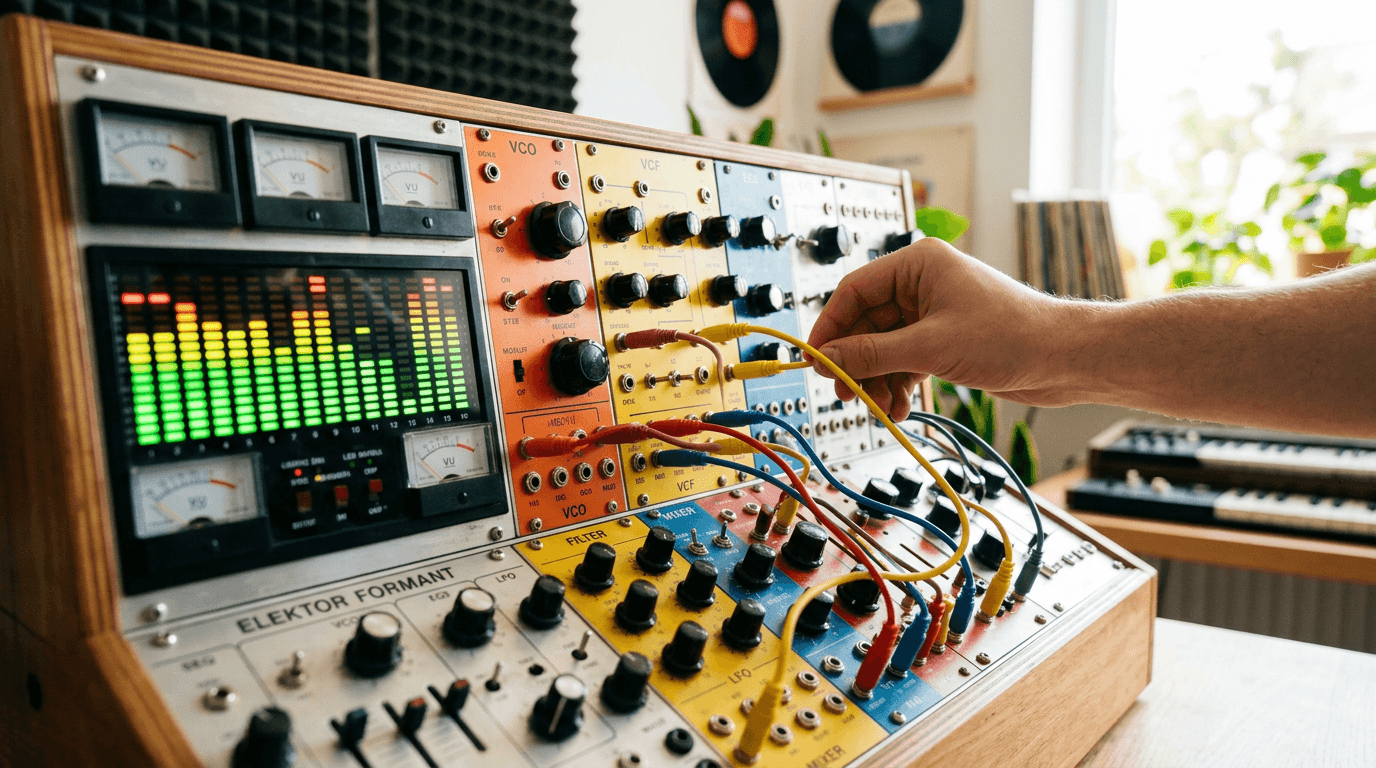
The Elektor Formant Revolution in DIY Synthesis
Learn more about nino wilson heey yo heey yo: live looping mastery
The Elektor Formant stands as a watershed moment in synthesizer history, democratizing modular synthesis when commercial systems cost as much as a house. Published in the Dutch electronics magazine Elektor during the late 1970s, this DIY modular synth brought professional-grade analog synthesis to hobbyists, students, and musicians who could not afford a Moog or ARP. The system's modular architecture, comprehensive feature set, and accessible design made it one of the most successful DIY synth projects ever conceived.
Two recently released videos have reignited interest in this legendary instrument, showcasing its capabilities and inspiring a new generation of builders. The Formant's influence extends far beyond its era, informing modern Eurorack designs and proving that great synthesis does not require corporate R&D budgets.
What Made the Elektor Formant Special?
The Formant emerged during synthesis's golden age, when manufacturers guarded their circuit designs jealously. Elektor magazine broke this barrier by publishing complete schematics, PCB layouts, and construction guides across multiple issues from 1977 to 1979. This transparency revolutionized how musicians approached electronic instrument building.
The system comprised individual modules that users could mix and match according to their needs and budget. Each module performed a specific function: voltage-controlled oscillators, filters, amplifiers, envelope generators, and more. This modular approach meant builders could start small and expand over time, making professional synthesis achievable on a hobbyist budget.
The Formant's sound quality rivaled commercial offerings of its era. Its oscillators delivered stable, rich tones across the audio spectrum. The filter, inspired by classic designs, provided smooth resonance and musical character that remains sought-after today.
Technical Specifications and Module Lineup
The complete Elektor Formant system included these essential modules:
For a deep dive on issues with r2r system on linux: audio production guide, see our full guide
- VCO (Voltage Controlled Oscillator): Generating sawtooth, triangle, and pulse waveforms with PWM capability
- VCF (Voltage Controlled Filter): 24dB/octave low-pass filter with resonance
- VCA (Voltage Controlled Amplifier): Exponential and linear response options
- ADSR Envelope Generator: Attack, Decay, Sustain, Release control over time
- LFO (Low Frequency Oscillator): Modulation source for vibrato, tremolo, and filter sweeps
- Noise Generator: White and pink noise for percussion and texture
- Ring Modulator: Creating metallic, bell-like timbres
- Sample and Hold: Stepped random voltages for experimental sounds
Each module operated on standard control voltages, making the system compatible with other synthesizers of the era. The 1V/octave standard meant the Formant could integrate with sequencers and keyboards from various manufacturers.
For a deep dive on project nomad: knowledge that never goes offline, see our full guide
How Do You Build Your Own Formant?
Constructing an Elektor Formant requires intermediate to advanced electronics skills. The original designs used through-hole components, making assembly more forgiving than modern surface-mount designs. However, sourcing authentic components presents challenges four decades later.
The power supply demands careful attention, as stable voltages ensure proper tuning and performance. The original design specified +15V, -15V, and +5V rails, which remain standard in modular synthesis today. Modern builders often upgrade power supplies with contemporary components for improved reliability.
PCB fabrication has become significantly easier since the 1970s. Enthusiast communities have digitized original layouts, and online PCB manufacturers can produce boards from Gerber files at low cost. Some vendors offer complete PCB sets specifically for Formant builders.
What Components Need Modern Substitutions?
Many original Formant components are obsolete, requiring careful substitution. The CA3080 operational transconductance amplifier, central to many designs, remains available but has modern equivalents. Builders must research each component to ensure replacements maintain circuit performance.
Capacitor technology has improved dramatically, offering better stability and smaller footprints. Polystyrene capacitors specified in original designs can be replaced with modern film types without sacrificing performance. Electrolytic capacitors benefit from contemporary low-ESR types that improve power supply filtering.
Transistors and integrated circuits require the most attention. While many 1970s semiconductors remain in production, others need careful cross-referencing. Online builder communities maintain extensive component substitution lists, sharing decades of collective experience.
How Does the Formant Sound Compare to Modern Synths?
The Elektor Formant produces classic analog warmth that digital emulations struggle to replicate perfectly. Its oscillators exhibit subtle instabilities that add organic character to sustained notes. The filter's resonance creates self-oscillation useful for sine wave generation and aggressive lead sounds.
Compared to contemporary Eurorack modules, the Formant offers similar functionality with vintage character. Modern modules often provide more precise control and additional features, but the Formant's straightforward design encourages experimentation. Its limitations inspire creativity, forcing users to work within boundaries that yield focused results.
The system excels at classic subtractive synthesis: fat bass lines, soaring leads, and evolving pads. Its modulation capabilities, while not as extensive as modern systems, cover essential synthesis techniques. The ring modulator produces distinctive metallic tones perfect for bell sounds and experimental textures.
How Do You Record and Integrate the Formant?
Integrating a Formant into modern production workflows requires attention to signal levels and impedance matching. The output typically runs at line level but may need buffering for optimal recording. A quality direct box or dedicated synth preamp ensures clean capture without loading the output stage.
The Formant responds beautifully to external processing. Vintage-style plate reverbs and tape delays complement its analog character. Modern producers often layer Formant recordings with digital synths, using the analog warmth to anchor otherwise sterile productions.
MIDI-to-CV converters unlock the Formant's potential in computer-based studios. These devices translate MIDI note data into control voltages, allowing DAW sequencing while maintaining analog signal paths. This hybrid approach combines modern workflow convenience with authentic analog synthesis.
Where Can You Find Formant Resources and Community Support?
A dedicated community of Formant enthusiasts maintains online forums, sharing schematics, build tips, and troubleshooting advice. These resources prove invaluable for builders encountering challenges or seeking modifications. Experienced builders often offer consultation services, helping newcomers avoid common pitfalls.
Several vendors specialize in Formant parts and complete kits. While not officially licensed reproductions, these offerings make building more accessible than sourcing individual components. Quality varies, so research and community recommendations help identify reliable suppliers.
The recent video documentation showcases fully operational Formant systems, demonstrating their sonic capabilities and inspiring new builds. These videos serve as both historical documentation and practical demonstrations, helping potential builders understand what they are undertaking.
Why Does the Elektor Formant Matter Today?
The Formant represents synthesis democratization at its finest. By publishing complete designs freely, Elektor empowered thousands to explore electronic music creation. This open-source ethos predated modern maker culture by decades, establishing principles that resonate throughout today's DIY electronics community.
Modern Eurorack synthesizers owe a debt to the Formant's modular architecture. While contemporary systems offer more compact designs and advanced features, the fundamental concepts remain unchanged. Understanding the Formant provides insight into synthesis fundamentals that apply across all platforms.
For producers seeking unique sounds, a working Formant offers sonic character unavailable elsewhere. Its particular combination of components, layout, and design creates a voice distinct from both modern recreations and other vintage synths. This individuality makes Formant recordings instantly recognizable to trained ears.
Is Building a Formant Worth the Effort?
The decision to build a Formant depends on your goals, skills, and resources. If you seek a weekend project, consider simpler DIY synths. The Formant demands significant time investment, typically 100-200 hours for a complete system. Component costs vary widely but expect $500-1000 minimum for a basic setup.
The educational value justifies the effort for many builders. Constructing a Formant teaches analog circuit theory, troubleshooting skills, and synthesis fundamentals. These lessons apply broadly across electronics and audio engineering, making the project an investment in knowledge.
Sonically, a well-built Formant delivers performance comparable to vintage synths costing thousands. The satisfaction of creating music with an instrument you built yourself adds intangible value that transcends monetary considerations.
Conclusion: A Living Legend
The Elektor Formant endures as a testament to innovative design and community-driven knowledge sharing. Its influence shaped synthesizer development and inspired countless musicians to explore electronics. Modern builders continue discovering its capabilities, proving that great design transcends technological obsolescence.
Continue learning: Next, explore tasks app update: 50+ intents & new interface for ios
Whether you build your own Formant or simply appreciate its historical significance, this legendary synth represents a pivotal moment when synthesis became accessible to everyone. The recent video documentation ensures new generations can experience and learn from this remarkable instrument. For those willing to invest the time and effort, the Formant offers rewards both sonic and educational that few projects can match.
Related Articles

AI's Role in Unveiling ICE Officers' Identities
AI unmasking ICE officers underscores a shift towards transparent law enforcement, raising questions about privacy and ethics in the digital age.
Sep 2, 2025

Age Verification Laws: Impact on Web Traffic Trends
Discover the paradox of age verification laws: How compliance impacts web traffic and the tech innovations shaping the future of digital content access.
Sep 2, 2025

Merz Tags Putin as Top War Criminal in Modern Era
Merz's assertion that Putin could be this era's gravest war criminal triggers a global debate on cybersecurity, AI, and warfare ethics.
Sep 3, 2025