275-Million-Year-Old Animal Had a Twisted Jaw Like Nothin...
Deep in a Brazilian riverbed, paleontologists found a 275-million-year-old fossil with a jaw so twisted and bizarre it challenges everything we know about ancient vertebrates.

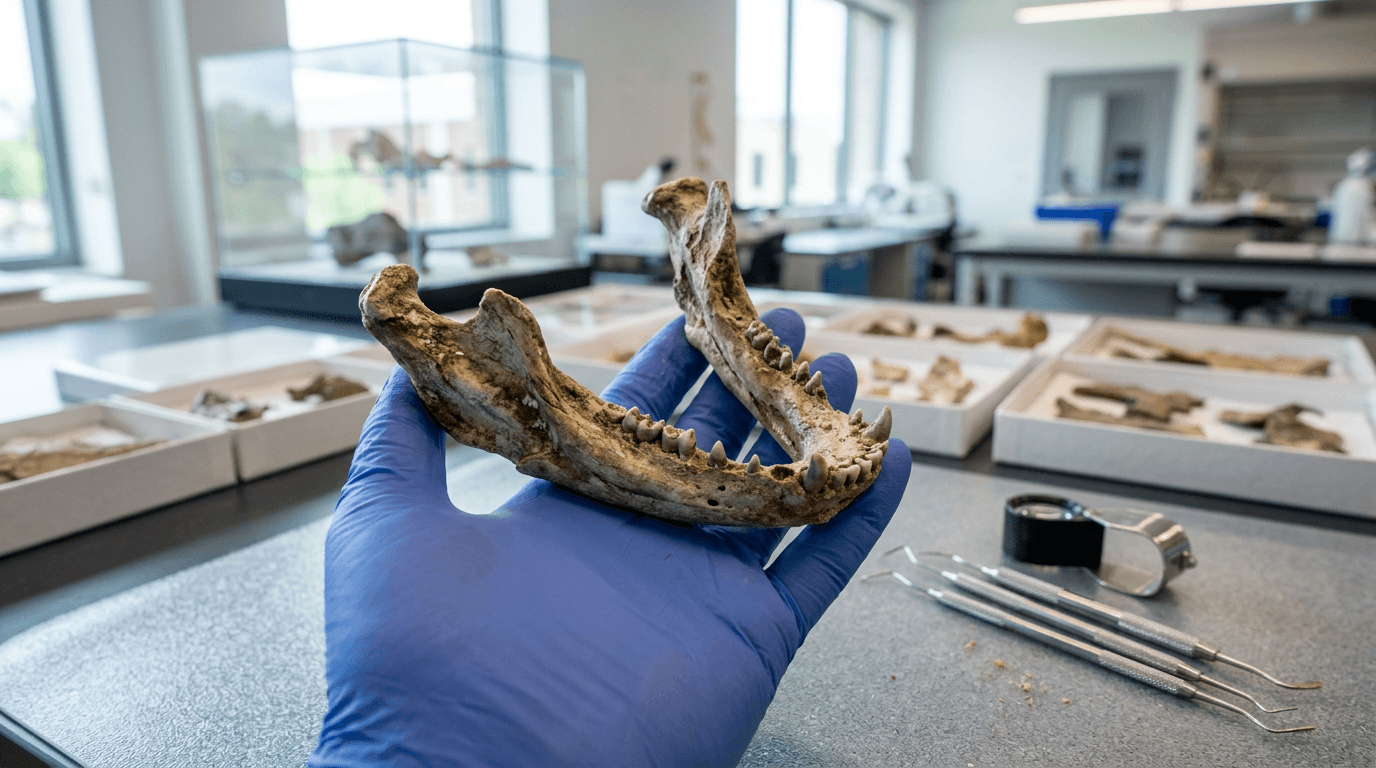
Ancient Creature with Twisted Jaw Rewrites Vertebrate Evolution
Learn more about how 'for all mankind' evolved into hard science fiction
Deep beneath the sun-baked surface of a dried Brazilian riverbed, paleontologists stumbled upon something extraordinary. The fossilized remains of a creature with a twisted jaw defied everything scientists knew about ancient vertebrates. This discovery pushes the boundaries of our understanding of prehistoric life and reveals how evolution sometimes takes the strangest paths.
What Makes the Tanyka Amnicola Discovery So Remarkable?
The 275-million-year-old fossil represents a creature named Tanyka amnicola, an animal that lived during the Permian period. Scientists found its remains in Brazil's fossil-rich deposits, where ancient riverbeds preserved countless secrets from Earth's distant past. The most striking feature of this prehistoric animal was its bizarrely twisted jawbone, a structure unlike anything seen in modern or extinct vertebrates.
Researchers identified Tanyka as a member of the microsaurs, a diverse group of small, lizard-like animals that thrived during the Carboniferous and Permian periods. By 275 million years ago, most microsaur lineages had already disappeared from the fossil record, making Tanyka a genuine "living fossil" of its era.
How Did This Ancient Creature's Jaw Differ from Modern Animals?
The jaw structure of Tanyka amnicola represents a genuine anatomical puzzle. Unlike the symmetrical jaws found in virtually all vertebrates today, this creature's lower jaw twisted in an asymmetrical pattern. The bones curved and rotated in ways that challenge our understanding of how feeding structures evolve and function.
This twisted configuration likely served a specific purpose related to the animal's lifestyle and diet. Paleontologists suggest several possibilities:
For a deep dive on seismic data captured the sound of awe during eclipse, see our full guide
- Specialized feeding mechanism for extracting prey from tight crevices
- Unique crushing ability for processing hard-shelled invertebrates
- Asymmetrical bite force distribution for specific food sources
- Adaptation to a particular ecological niche in ancient river systems
The jaw's unusual architecture required significant modifications to the surrounding musculature and skull structure. These adaptations demonstrate how evolution produces unexpected solutions to survival challenges.
For a deep dive on trump celebrates artemis ii astronauts at white house, see our full guide
Why Did Tanyka Survive When Its Relatives Went Extinct?
Most microsaurs disappeared during the late Carboniferous period, roughly 300 million years ago. Yet Tanyka survived at least 25 million years beyond its relatives' extinction. This persistence raises intriguing questions about evolutionary resilience and ecological refuges.
The Brazilian riverbed environment may have provided a stable habitat where this unusual creature could thrive long after its cousins vanished. Scientists continue investigating what environmental factors allowed Tanyka to persist as a "living fossil" of its time.
How Do Microsaurs Fit into Vertebrate Evolution?
Microsaurs occupied an important position in vertebrate evolution, though scientists still debate their exact relationships to modern animals. These small creatures typically measured between 10 and 30 centimeters in length. They displayed remarkable diversity in body forms, from snake-like species to robust, heavily built varieties.
What Techniques Reveal Secrets of Ancient Fossils?
Modern paleontology employs sophisticated techniques to extract maximum information from fossil specimens. Researchers used high-resolution CT scanning to examine Tanyka's skull without damaging the delicate fossil. These scans revealed the internal structure of the twisted jaw and how it connected to the rest of the skull.
Comparative anatomy played a crucial role in understanding this discovery. Scientists compared Tanyka's features with hundreds of other microsaur specimens and modern vertebrates. This analysis helped reconstruct how the animal might have moved, fed, and interacted with its environment.
The fossil's preservation quality proved exceptional, allowing researchers to observe fine details of bone texture and joint surfaces. Such preservation occurs only under specific conditions, typically when sediment rapidly buries an organism before decomposition begins.
What Was the Permian Environment Like?
The Permian period witnessed dramatic changes in Earth's climate and ecosystems. Continental landmasses had assembled into the supercontinent Pangaea, creating vast interior deserts and altering ocean circulation patterns. The Brazilian region where Tanyka lived likely featured a more humid climate with extensive river systems.
Ancient rivers teemed with diverse life forms, from primitive fish to early amphibians and reptile-like creatures. Tanyka shared its habitat with various other small vertebrates, insects, and aquatic invertebrates. Competition for food resources likely drove the evolution of specialized features like the twisted jaw.
The Late Permian period would eventually culminate in the most devastating mass extinction in Earth's history, occurring roughly 25 million years after Tanyka's time. This extinction event eliminated over 90% of marine species and 70% of terrestrial vertebrates.
Why Do Unusual Anatomical Features Matter?
Tanyka's twisted jaw reminds us that evolution operates without predetermined goals or limitations. Natural selection favors whatever works in a given environment, regardless of how bizarre the result might appear. This principle has produced countless unusual adaptations throughout Earth's history.
Do Modern Animals Show Similar Asymmetrical Adaptations?
While no living animal possesses a jaw quite like Tanyka's, nature offers numerous examples of asymmetrical or specialized feeding structures. Flatfish have both eyes on one side of their heads. Crossbill finches possess crossed mandibles for extracting seeds from pinecones.
The narwhal's spiral tusk grows from its left incisor tooth. These modern examples demonstrate that asymmetry can provide significant survival advantages. They also help scientists develop hypotheses about how extinct creatures like Tanyka might have used their unusual features.
What Does This Discovery Mean for Vertebrate Evolution?
The discovery of Tanyka amnicola expands our knowledge of vertebrate diversity during a critical period in Earth's history. It demonstrates that ancient ecosystems supported a wider range of body plans and adaptations than previously recognized. Each unusual fossil fills gaps in our understanding of evolutionary possibilities.
This finding also highlights the importance of exploring underexamined fossil sites. Brazil's Permian deposits have yielded numerous significant discoveries in recent years, yet many areas remain unstudied. Future expeditions will likely uncover additional surprises that challenge our assumptions about prehistoric life.
What Can We Learn from a Twisted Jaw?
Tanyka amnicola's bizarre anatomy teaches us valuable lessons about evolution, adaptation, and the incredible diversity of life across geological time. This 275-million-year-old creature survived long after its relatives vanished, thriving with a jaw structure that defies conventional vertebrate design.
The twisted jaw of this ancient animal represents more than just an anatomical curiosity. It exemplifies how life adapts to environmental challenges through unexpected solutions. As scientists continue studying this remarkable fossil, they will undoubtedly uncover additional insights into how ancient ecosystems functioned and how evolution shapes the living world.
Continue learning: Next, explore spacex rocket stage to slam into moon in august 2022
Each discovery like Tanyka brings us closer to understanding the full scope of life's incredible journey across billions of years. The fossil record continues revealing surprises that expand our knowledge of what's possible in vertebrate evolution.
Related Articles

Dinosaur Teeth Uncover Jurassic Life Secrets
Dinosaur teeth studies reveal fascinating insights into their diets, migration patterns, and how climate shaped Jurassic life 150 million years ago.
Sep 8, 2025

Unraveling the Moon’s Magnetic Mysteries: A New Theory
MIT's groundbreaking study suggests the moon's magnetic anomalies are due to a colossal asteroid impact, offering new insights into lunar history.
Sep 7, 2025

Mars Colony Milestone: First Successful Human Landing
The first astronauts have successfully landed on Mars, marking a new chapter in human history and space exploration. Discover the science behind the mission.
Sep 6, 2025
Comments
Loading comments...