How 'For All Mankind' Evolved Into Hard Science Fiction
"For All Mankind" began as a 1960s space race drama but evolved into hard science fiction rivaling "The Expanse." Discover how the show maintains scientific accuracy while depicting humanity's future.

How Did "For All Mankind" Evolve Into Hard Science Fiction?
Learn more about doordash mother's day gifting hub transforms delivery app
"For All Mankind" started as a nostalgic period drama about the space race, but it has transformed into something far more ambitious. The Apple TV+ series now rivals "The Expanse" in its commitment to hard science fiction, depicting a future where humanity's reach extends beyond Earth with stunning technical accuracy.
This evolution reflects how speculative fiction can mature alongside its audience, trading historical nostalgia for bold predictions about humanity's future in space.
How Did the Show Transform From Historical Drama to Hard Science Fiction?
The show's first season premiered in 2019 as an alternate history tale, asking a simple question: what if the Soviet Union had won the race to the moon? Creator Ronald D. Moore, known for his work on "Battlestar Galactica," grounded the series in meticulous period detail. The sets, costumes, and technology all reflected the 1960s and 1970s with documentary-level precision.
By season four, "For All Mankind" has leaped forward to 2003 in its alternate timeline. The show now depicts asteroid mining operations, fusion-powered spacecraft, and permanent settlements on Mars. This transformation from "The Right Stuff" into something resembling "The Expanse" represents one of television's most ambitious genre shifts.
What Science Powers This Transformation?
The series employs actual aerospace engineers and NASA consultants to ensure technical accuracy. Garrett Reisman, a former NASA astronaut, serves as a technical advisor and has shaped how the show depicts everything from spacecraft design to orbital mechanics.
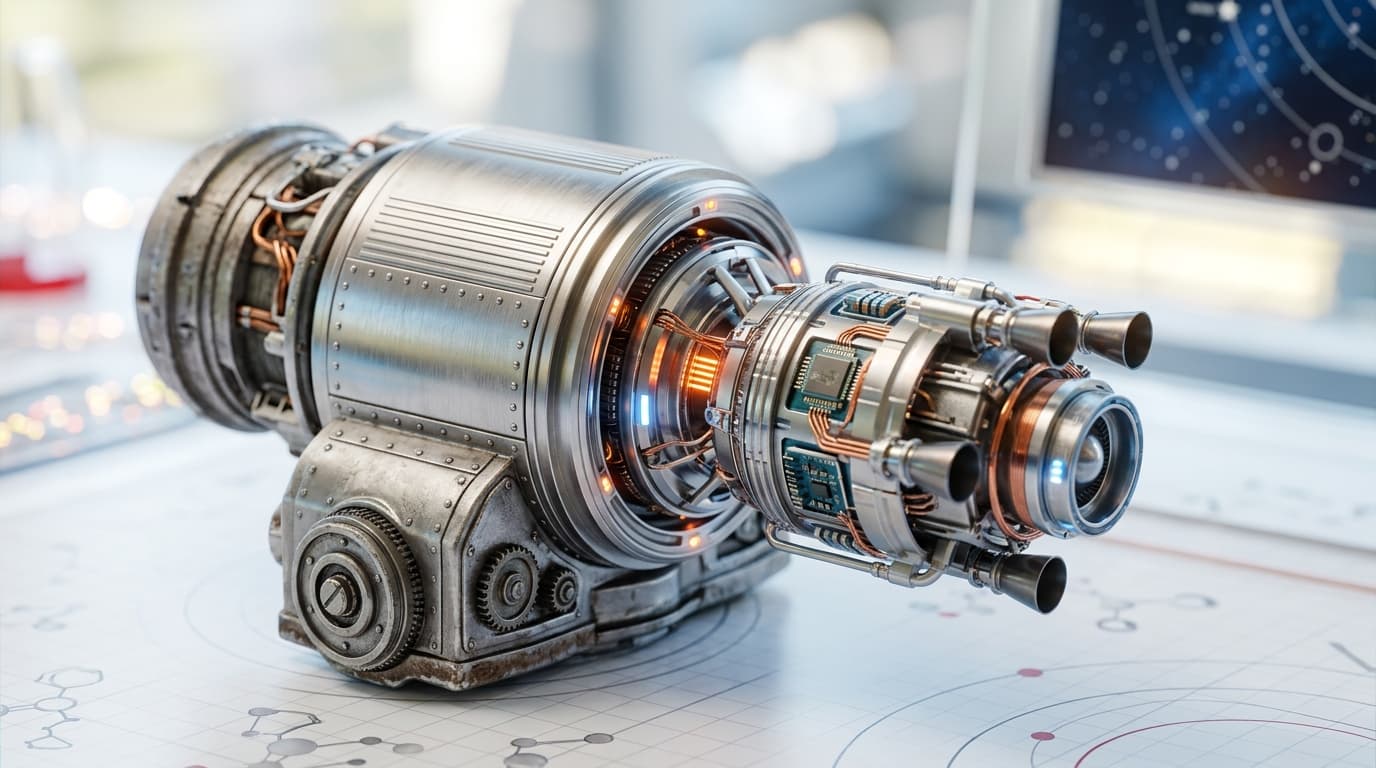
The show's depiction of nuclear thermal propulsion draws directly from real NASA research. The engines shown in the series use principles that engineers have studied since the 1960s. These aren't fantasy devices but plausible extrapolations of existing technology.
What Defines "For All Mankind" as Hard Science Fiction?
For a deep dive on ti-84 evo: texas instruments' next-gen calculator, see our full guide
Hard science fiction prioritizes scientific accuracy and plausibility over spectacle. "For All Mankind" now embraces this philosophy fully, depicting space travel with its inherent dangers and limitations. Ships don't make sound in vacuum, orbital mechanics matter, and radiation poses constant threats to crew members.
The show's writers consult current research papers and engineering proposals. When depicting asteroid mining in season four, they referenced actual studies from planetary scientists about resource extraction in microgravity.
For a deep dive on one marketing question that built a 30-year business, see our full guide
Which Scientific Elements Does the Show Get Right?
The series nails several crucial aspects:
Orbital mechanics: Spacecraft follow realistic trajectories based on Hohmann transfer orbits and delta-v calculations.
Life support systems: The show depicts closed-loop environmental systems similar to those proposed for actual Mars missions.
Radiation shielding: Characters discuss and implement real protective measures against cosmic rays and solar radiation.
Propulsion technology: The nuclear thermal rockets shown use designs from actual NASA and DOE research programs.
Economic realities: The series explores how commercial interests drive space development, mirroring current trends in the aerospace industry.
How Does the Alternate Timeline Create Plausible Technology?
The show's alternate timeline diverges from real history at a critical juncture. The continued space race funding in the 1970s and 1980s allowed technologies to mature that stagnated in our world.
NASA's budget peaked at 4.4% of the federal budget in 1966. In our timeline, it dropped to less than 1% by the 1970s. "For All Mankind" imagines a world where competition kept funding high, accelerating development of nuclear propulsion, advanced materials, and life support systems.
How Do Writers Balance Real Science With Alternate History?
The show's writers work backward from real scientific possibilities. They ask: if we had developed this technology by 1980, what becomes possible by 1990? This methodical approach creates a believable progression from historical drama to hard science fiction.
The Mars base depicted in later seasons uses in-situ resource utilization (ISRU) to produce fuel and oxygen. This technology exists today in prototype form. NASA's Perseverance rover carried the MOXIE experiment, which successfully produced oxygen from Martian atmosphere in 2021.
Why Does Scientific Accuracy Matter in Space Fiction?
Accurate science fiction serves a purpose beyond entertainment. It helps audiences understand real challenges facing space exploration and inspires the next generation of engineers and scientists. When viewers see realistic depictions of orbital mechanics or radiation hazards, they gain appreciation for the complexity of actual space missions.
The show also explores social and political dimensions of space exploration. How do international tensions play out beyond Earth? What legal frameworks govern resource extraction on asteroids?
Can the Show Actually Teach Real Science?
Physics teachers have reported using clips from "For All Mankind" to illustrate concepts like Newton's laws in microgravity or the rocket equation. The show makes abstract principles tangible by showing their consequences in dramatic situations.
How Does "For All Mankind" Compare to "The Expanse"?
Both shows share a commitment to realistic physics and plausible technology. "The Expanse" takes place centuries in the future with more advanced propulsion systems, but it maintains similar attention to detail. Ships accelerate at constant rates to generate artificial gravity, combat happens across vast distances, and characters deal with the physiological effects of different gravitational environments.
"For All Mankind" operates on a shorter timeline, making its technology feel more immediately achievable. The fusion drives and asteroid mining operations depicted could theoretically exist within decades given sufficient investment.
What Makes Each Show's Approach Unique?
While "The Expanse" explores humanity spread across the solar system, "For All Mankind" shows how we might get there. The latter serves as a potential prequel to the former's universe, depicting the crucial transition from planetary species to spacefaring civilization.
What Does the Future Hold for "For All Mankind"?
Each season of "For All Mankind" jumps forward roughly a decade, allowing the show to explore increasingly advanced technology. Moore has indicated the series could continue through the 21st century, potentially depicting interstellar missions or permanent space habitats.
This structure lets the show maintain its hard science fiction credentials while continuing to surprise viewers.
What Technologies Might Future Seasons Explore?
Future seasons will likely explore:
- Advanced propulsion systems like fusion rockets or antimatter drives
- Permanent orbital habitats and space-based manufacturing
- The social evolution of off-world communities
- First contact scenarios grounded in actual astrobiology
- Climate engineering and planetary protection technologies
Why Does This Evolution Matter for Science Fiction Television?
"For All Mankind" has successfully evolved from period piece to hard science fiction by maintaining rigorous scientific standards while accelerating its timeline. The show demonstrates that accurate science enhances rather than limits storytelling possibilities.
Continue learning: Next, explore jonah hill's 'cut off' loses july release date from wb
By grounding its vision in real physics and engineering, the series offers both entertainment and inspiration. It shows audiences a plausible path to humanity's future among the stars. This transformation from "The Right Stuff" nostalgia to "The Expanse"-level worldbuilding proves that television science fiction can be both dramatically compelling and scientifically rigorous.
Related Articles

Mars Colony Milestone: First Successful Human Landing
The first astronauts have successfully landed on Mars, marking a new chapter in human history and space exploration. Discover the science behind the mission.
Sep 6, 2025

Anthropic's $1.5B Settlement: A Turning Point for AI & Authors
Anthropic agrees to a $1.5B settlement with book authors, highlighting the complex relationship between AI development and copyright laws.
Sep 6, 2025

Kim Kardashian vs. Homeland Security: A Reality Clash
Kim Kardashian condemned ICE raids, prompting Homeland Security to label her 'misinformed'. The clash underscores the power of celebrity activism.
Sep 6, 2025
Comments
Loading comments...