Antimatter Traveled by Truck for the First Time in History
In a groundbreaking achievement, scientists at CERN successfully transported antimatter by truck for the first time in history, paving the way for an antimatter delivery service across Europe.

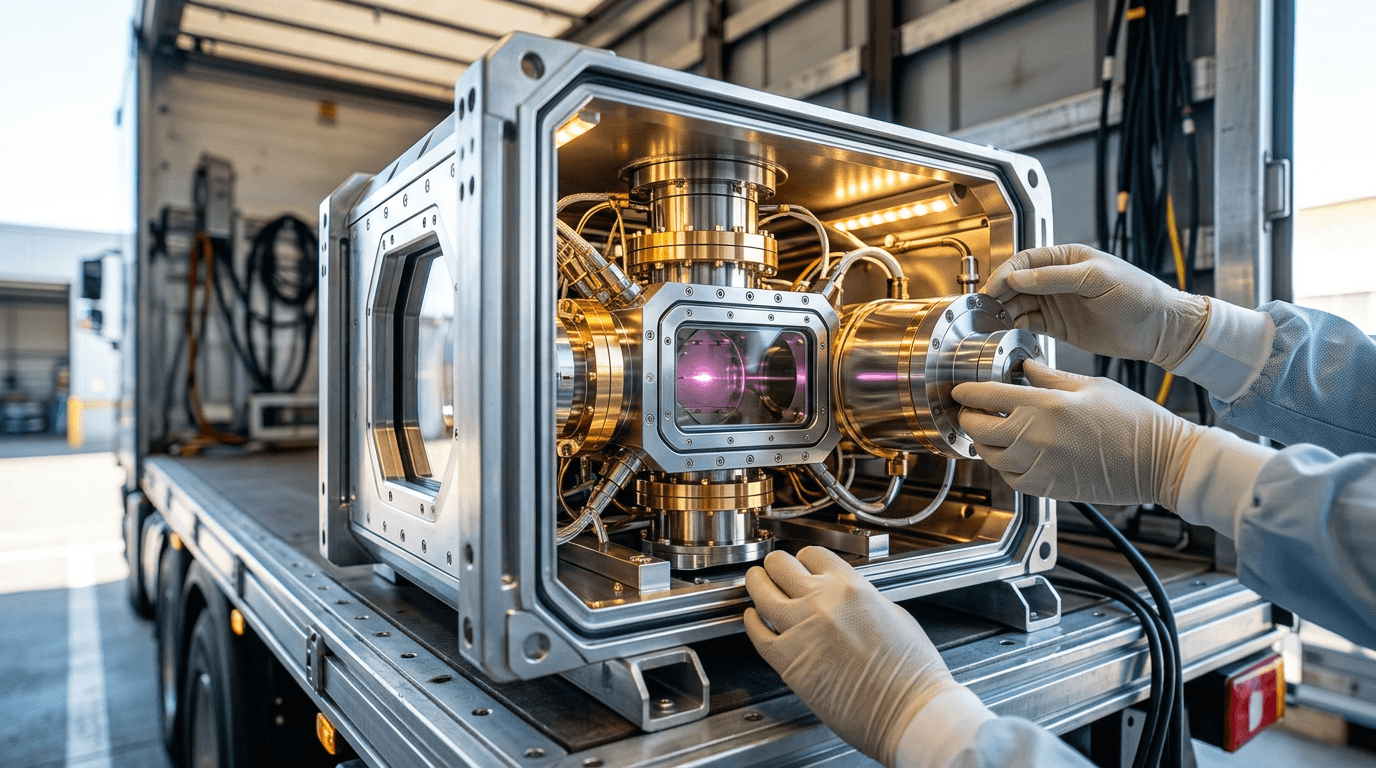
Antimatter Traveled by Truck: A Historic Scientific Milestone
Learn more about snapdragon 8 elite gen 6 specs leaked: business impact
Scientists successfully transported antimatter by truck for the first time in history, marking a revolutionary breakthrough in particle physics. Researchers from CERN moved antiprotons across their Geneva campus in a specially designed magnetic trap. The journey lasted only a few minutes, but it opens doors to possibilities that once seemed like pure science fiction.
The successful transport challenges decades of assumptions about handling the universe's most volatile substance. Antimatter annihilates instantly upon contact with regular matter, releasing tremendous energy. Yet researchers proved they could safely move these exotic particles outside laboratory confines, potentially transforming how scientists worldwide conduct antimatter research.
How Did Scientists Transport Antimatter by Truck?
The CERN team used a sophisticated magnetic trap mounted on a truck to complete this historic journey. The device, called BASE-STEP (Baryon Antibaryon Symmetry Experiment Superconducting Trap for Experimental Particles), kept approximately 70 antiprotons suspended in a vacuum using powerful magnetic fields. These particles remained stable throughout the entire transport process.
The trap maintained temperatures near absolute zero, just 0.015 degrees above -273.15°C. This extreme cooling prevented the antiprotons from gaining energy and escaping their magnetic prison.
Researchers monitored the antiprotons continuously during transport using sophisticated detection equipment. Every single antiproton arrived safely at its destination. This success rate demonstrates the trap's effectiveness and the team's precise engineering.
Why Is Transporting Antimatter So Challenging?
For a deep dive on goodbye to sora: what openai's video ai means for content, see our full guide
When an antiproton meets a regular proton, both particles instantly vanish, converting their mass into pure energy according to Einstein's famous equation E=mc². This makes storing and moving antimatter extraordinarily difficult.
Scientists face several critical challenges when handling antimatter:
For a deep dive on apple's 6 new products could launch soon per rumors, see our full guide
- Perfect isolation required: Antimatter cannot touch any regular matter, including air molecules or container walls
- Extreme vacuum conditions: The storage chamber must maintain pressures lower than outer space
- Powerful magnetic confinement: Only magnetic fields can hold charged antimatter particles without physical contact
- Cryogenic temperatures: Ultra-cold conditions keep antimatter particles from escaping magnetic traps
- Vibration sensitivity: Movement and shaking can destabilize the delicate magnetic containment
The BASE-STEP trap overcomes these obstacles through ingenious engineering. Its superconducting magnets create an invisible cage that holds antiprotons suspended in perfect vacuum. Battery power keeps the system running independently for hours, eliminating reliance on external power sources during transport.
What Could Antimatter Delivery Mean for Science?
CERN researchers envision a future antimatter delivery service that could revolutionize particle physics research across Europe. Currently, only a handful of facilities worldwide can produce antimatter, with CERN's Antiproton Decelerator being the primary source. This monopoly limits research opportunities for scientists at other institutions.
An antimatter delivery program would democratize access to these rare particles. Researchers at universities and laboratories throughout Europe could receive regular shipments of antiprotons for their experiments. This distribution network would dramatically accelerate antimatter research without requiring every institution to build expensive production facilities.
The scientific applications extend far beyond basic research. Medical researchers could use transported antimatter to develop better PET scanners and cancer treatments. Antimatter imaging already plays a crucial role in modern medicine, but wider availability could spark new innovations in diagnostic technology.
How Does CERN Produce Antimatter?
CERN creates antimatter using its particle accelerator complex, a process that requires enormous energy and sophisticated equipment. Protons accelerated to near light speed collide with metal targets, producing various particles including antiprotons. These antimatter particles emerge traveling at tremendous speeds and must be slowed down for storage.
The Antiproton Decelerator facility reduces antiproton velocities from 90% of light speed to just 10%. This cooling process involves multiple stages of electromagnetic manipulation. Once slowed sufficiently, magnetic traps can capture and hold the antiprotons for extended periods.
Producing antimatter remains incredibly expensive and inefficient. Creating a single gram of antiprotons would cost approximately $100 trillion and consume more energy than humanity produces in a year. Current production rates measure in billionths of a gram annually, making antimatter the rarest and most expensive substance on Earth.
What Are the Energy Requirements for Antimatter Production?
CERN's antimatter production consumes massive amounts of electricity to operate particle accelerators and cooling systems. The facility can produce roughly 50 million antiprotons per minute when running at full capacity. While this sounds impressive, it represents an infinitesimal amount of actual matter.
These production limitations mean antimatter won't fuel spacecraft or power cities anytime soon. The energy required to create antimatter far exceeds the energy released when it annihilates. However, even tiny amounts prove invaluable for scientific research into fundamental physics questions.
What Experiments Could Benefit from Antimatter Transport?
Numerous research programs could leverage portable antimatter to advance scientific understanding. Precision measurements of antimatter properties help physicists test fundamental theories about the universe's structure. Scientists want to determine why our universe contains matter but virtually no antimatter, one of physics' greatest unsolved mysteries.
Gravity experiments represent another promising application. Researchers have never definitively measured whether antimatter falls up or down in Earth's gravitational field. Theory predicts antimatter should fall downward like regular matter, but experimental confirmation remains elusive. Transporting antimatter to specialized facilities could enable these crucial tests.
Quantum physics experiments could also benefit from antimatter delivery services. Antiprotons enable unique studies of quantum entanglement and fundamental symmetries. Making these particles available to more research groups would accelerate discoveries in quantum mechanics and related fields.
What Does the Future Hold for Antimatter Transportation?
The successful truck transport represents just the beginning of antimatter mobility. CERN scientists plan to extend transport distances gradually, eventually moving antiprotons hundreds of kilometers to partner institutions. Each journey will test the technology's limits and identify improvements for longer trips.
Future versions of the transport trap may hold larger quantities of antimatter for extended periods. Engineers are developing more efficient cooling systems and more powerful magnetic confinement. These advances could enable transcontinental antimatter shipments within decades.
Regulatory frameworks will need to evolve alongside the technology. Governments must establish safety protocols for transporting antimatter on public roads. While the quantities involved pose minimal danger, the exotic nature of the cargo demands careful oversight and public communication.
Is Transporting Antimatter Safe?
The tiny amounts of antimatter being transported present negligible safety risks. If the magnetic trap failed and all antiprotons annihilated simultaneously, they would release less energy than a firecracker. The 70 antiprotons in the first transport contained only about one-trillionth of a joule of energy.
Public perception may prove more challenging than actual safety concerns. Antimatter's portrayal in popular culture often exaggerates its explosive potential. Scientists must communicate clearly that research quantities differ vastly from fictional antimatter bombs.
The transport containers include multiple redundant safety systems. Battery backups ensure magnetic fields remain active even during power interruptions. Monitoring equipment alerts researchers immediately if containment parameters deviate from safe ranges. These precautions make antimatter transport safer than many conventional hazardous materials already traveling on roads daily.
A New Era for Antimatter Research
The first successful antimatter transport by truck marks a pivotal moment in particle physics history. This achievement transforms antimatter from a laboratory curiosity into a transportable resource that could revolutionize scientific research. CERN's vision of an antimatter delivery program promises to democratize access to these exotic particles, enabling discoveries that would otherwise remain impossible.
Continue learning: Next, explore akai mpc sample review: back to the roots of beatmaking
As technology advances and transport distances increase, antimatter research will expand beyond CERN's walls to institutions across Europe and eventually worldwide. This distribution network will accelerate our understanding of fundamental physics questions while potentially spawning practical applications in medicine and technology. The successful truck journey represents the beginning of antimatter's journey into the broader scientific world.
Related Articles

iPhone 17 Unveiled: Features & Expectations
With the iPhone 17 launch just a week away, explore the rumored features, technological advancements, and Apple's push for sustainability.
Sep 5, 2025

Atlassian's Strategic Move: Acquiring The Browser Company
Atlassian's acquisition of The Browser Company marks a significant shift towards integrated, innovative digital workspaces and team collaboration tools.
Sep 4, 2025

Unpacking The Bitter Lesson in AI Evolution
Delving into the Bitter Lesson in AI: Unraveling its true meaning and impact on future technological innovations and trends.
Sep 4, 2025