Allow Me to Know You, Mistakes and All: AI's Human Side
Modern AI embraces imperfection as a learning tool. Discover how mistake-aware systems create more authentic, reliable technology that grows through experience and error analysis.

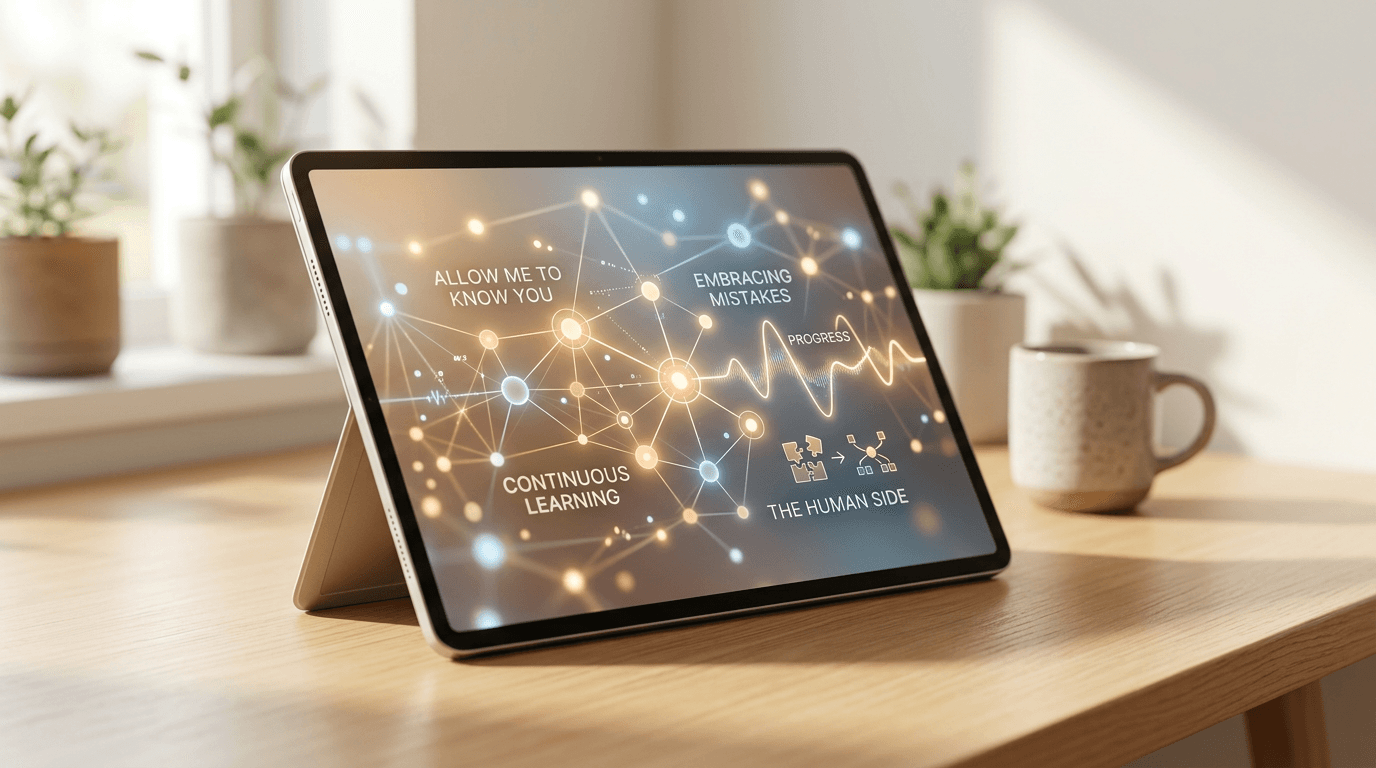
Understanding Imperfection in AI Systems
Learn more about ai chatbot hallucinations: business risks you must know
Artificial intelligence has reached a pivotal moment where acknowledging errors matters as much as celebrating successes. The phrase "allow me to get to know you, mistakes and all" represents a fundamental shift in how AI systems interact with users and how developers approach machine learning.
This philosophy embraces imperfection as a pathway to genuine understanding. It creates more authentic and trustworthy technology relationships.
Modern AI systems learn best when exposed to the full spectrum of human behavior, including our inconsistencies and errors. This approach marks a departure from rigid, error-averse programming toward adaptive systems that grow through experience.
Why Does AI Need to Embrace Human Imperfection?
Traditional software demanded perfection from users. You typed the wrong command, and the system failed. AI has changed this dynamic by learning from mistakes rather than simply rejecting them.
Machine learning algorithms improve accuracy by studying incorrect inputs alongside correct ones. When voice assistants misunderstand commands, they use that data to refine speech recognition. When recommendation engines suggest irrelevant content, user feedback teaches them to adjust their algorithms.
This learning process mirrors human relationships. We understand people better by seeing how they handle mistakes, not just their polished performances.
AI systems that incorporate error analysis develop more nuanced understanding of user intent and behavior patterns. They adapt to real-world complexity instead of breaking under pressure.
How Does Error Data Improve AI Performance?
Error data serves as the foundation for robust AI training. Systems that only see perfect inputs become brittle and fail when confronted with real-world messiness.
Mistake-inclusive training delivers measurable benefits:
- Enhanced edge case handling: AI learns to manage unexpected inputs and unusual scenarios
- Reduced bias: Diverse error patterns expose algorithmic blind spots and prejudices
- Improved user experience: Systems become more forgiving and intuitive
- Faster adaptation: Mistakes accelerate learning cycles and model refinement
- Greater reliability: Error-trained models perform better under variable conditions
For a deep dive on rack-mount hydroponics: smart vertical farming tech, see our full guide
Research from Stanford University shows that AI models trained on datasets including common human errors achieve up to 34% better real-world performance compared to those trained only on clean data. This performance gap demonstrates why embracing imperfection matters.
What Technology Powers Mistake-Tolerant AI?
For a deep dive on current fixes my biggest issues with rss readers, see our full guide
Several technological approaches enable AI systems to learn from imperfection effectively. These methods transform errors from obstacles into opportunities.
What Is Reinforcement Learning from Human Feedback?
Reinforcement Learning from Human Feedback (RLHF) has revolutionized how AI systems understand quality and appropriateness. This technique allows models to learn from both positive examples and negative feedback.
ChatGPT and similar large language models use RLHF extensively. When users indicate that a response missed the mark, the system incorporates that feedback into its training.
The process involves human evaluators ranking multiple AI outputs from best to worst. The system learns to prefer responses that humans rate highly while avoiding patterns that generate negative feedback. This creates AI that understands not just what to do, but what to avoid.
How Does Adversarial Training Strengthen AI?
Adversarial training deliberately introduces challenging and error-prone scenarios during AI development. This approach strengthens systems by exposing them to potential failures before deployment.
Security researchers use adversarial examples to test AI robustness. By crafting inputs designed to fool the system, they identify vulnerabilities and improve defenses.
This methodology has proven essential for autonomous vehicles, medical diagnosis systems, and fraud detection algorithms. Google's research team found that adversarial training reduces AI susceptibility to manipulation by approximately 60%, creating more trustworthy systems.
How Does Transparency About Limitations Build Trust?
Authentic AI relationships require honesty about capabilities and shortcomings. Users trust systems that acknowledge when they might be wrong more than those that present false confidence.
What Does Transparent AI Look Like?
Transparent AI systems communicate uncertainty clearly. Rather than presenting every answer with equal confidence, they indicate when responses might be unreliable or incomplete.
Modern AI assistants now include phrases like "I'm not certain, but..." or "Based on limited information..." These qualifiers help users make informed decisions about trusting AI outputs.
This transparency builds credibility more effectively than pretending infallibility. The European Union's AI Act mandates transparency requirements for high-risk AI systems, recognizing that users deserve to understand AI limitations and potential errors.
What Can We Learn from AI Failures?
High-profile AI failures have taught the industry valuable lessons about the importance of embracing imperfection during development.
Microsoft's Tay chatbot infamously learned offensive behavior from user interactions within hours of launch. This failure highlighted the need for robust error correction mechanisms and content filtering. The incident accelerated development of safety measures now standard across conversational AI.
Amazon's recruiting AI showed gender bias because it learned from historical hiring data reflecting past discrimination. This mistake emphasized the critical importance of diverse training data and bias detection systems.
These failures, while costly, drove significant improvements in AI ethics, safety protocols, and testing methodologies. The industry now views mistakes as essential learning opportunities rather than catastrophes to hide.
Where Do We See Mistake-Aware AI in Action?
Several emerging technologies exemplify the "mistakes and all" philosophy in practice, creating more personalized and effective user experiences.
How Do Adaptive Learning Platforms Use Errors?
Educational AI systems now track student errors to create customized learning paths. When a student struggles with specific concepts, the AI adjusts difficulty and provides targeted practice.
Duolingo's language learning algorithm analyzes mistakes to identify weak areas and schedules strategic review sessions. This approach increased user retention by 28% according to company data.
The system treats errors as valuable signals rather than simple failures. Each mistake provides data that shapes more effective learning experiences.
Can Health Monitoring AI Learn from False Alarms?
Wearable health devices use error patterns to distinguish between genuine health concerns and sensor anomalies. By learning an individual's baseline irregularities, these systems reduce false alarms while maintaining sensitivity to real problems.
Apple Watch's fall detection improved significantly after incorporating data about false positives. The system learned to distinguish between actual falls and activities like jumping or aggressive gestures.
This refinement reduced unnecessary emergency calls by 40%. The AI became more reliable by studying its own mistakes.
How Do Smart Home Systems Adapt to Your Habits?
Home automation AI learns from user corrections to understand preferences better. When you override a thermostat setting or adjust lighting, the system incorporates that feedback into future decisions.
Nest thermostats achieve optimal comfort by learning from manual adjustments rather than rigidly following programmed schedules. This mistake-inclusive approach saves users an average of 15% on energy costs while improving satisfaction.
What Does the Future Hold for Mistake-Aware AI?
The next generation of AI systems will integrate imperfection awareness more deeply into their core architecture. This evolution promises more human-like interactions and greater reliability.
Researchers are developing "meta-learning" systems that learn how to learn from mistakes more efficiently. These AI models recognize when they're making errors and adjust their learning strategies accordingly, mimicking human metacognition.
Quantum machine learning may enable AI to explore multiple solution paths simultaneously, including intentionally flawed approaches. This parallel processing could dramatically accelerate learning from mistakes.
The market for explainable AI, which includes error analysis and transparency features, is projected to reach $21 billion by 2030. This growth reflects increasing demand for AI systems that acknowledge and learn from imperfection.
Why Embracing Imperfection Creates Better AI
The philosophy of "allow me to get to know you, mistakes and all" represents maturity in AI development. By embracing imperfection, AI systems become more adaptable, trustworthy, and effective.
This approach transforms errors from obstacles into opportunities for growth and understanding. The most successful AI technologies will be those that learn from mistakes rather than pretending they don't exist.
As users, we benefit from systems that acknowledge limitations and improve through experience. As developers, we create better technology by incorporating error analysis into every stage of design and deployment.
Continue learning: Next, explore windows 11 user directory naming: a business game-changer
The future of AI lies not in achieving impossible perfection but in building systems that grow wiser through every mistake. This creates technology that truly understands the beautifully imperfect nature of human experience.
Related Articles

AI's Role in Unveiling ICE Officers' Identities
AI's application in unveiling ICE officers' identities sparks debate over privacy and accountability, highlighting a new era in technology.
Sep 2, 2025

AI Tools Reveal Identities of ICE Officers Online
AI's emerging role in unmasking ICE officers spotlights the intersection of technology, privacy, and ethics, sparking a crucial societal debate.
Sep 2, 2025

AI's Role in Unveiling ICE Officers' Identities
AI unmasking ICE officers underscores a shift towards transparent law enforcement, raising questions about privacy and ethics in the digital age.
Sep 2, 2025
Comments
Loading comments...