$96 3D-Printed Rocket Recalculates Trajectory Mid-Flight
A breakthrough in affordable rocketry shows how 3D printing and budget sensors are democratizing aerospace technology, proving innovation doesn't require massive budgets.

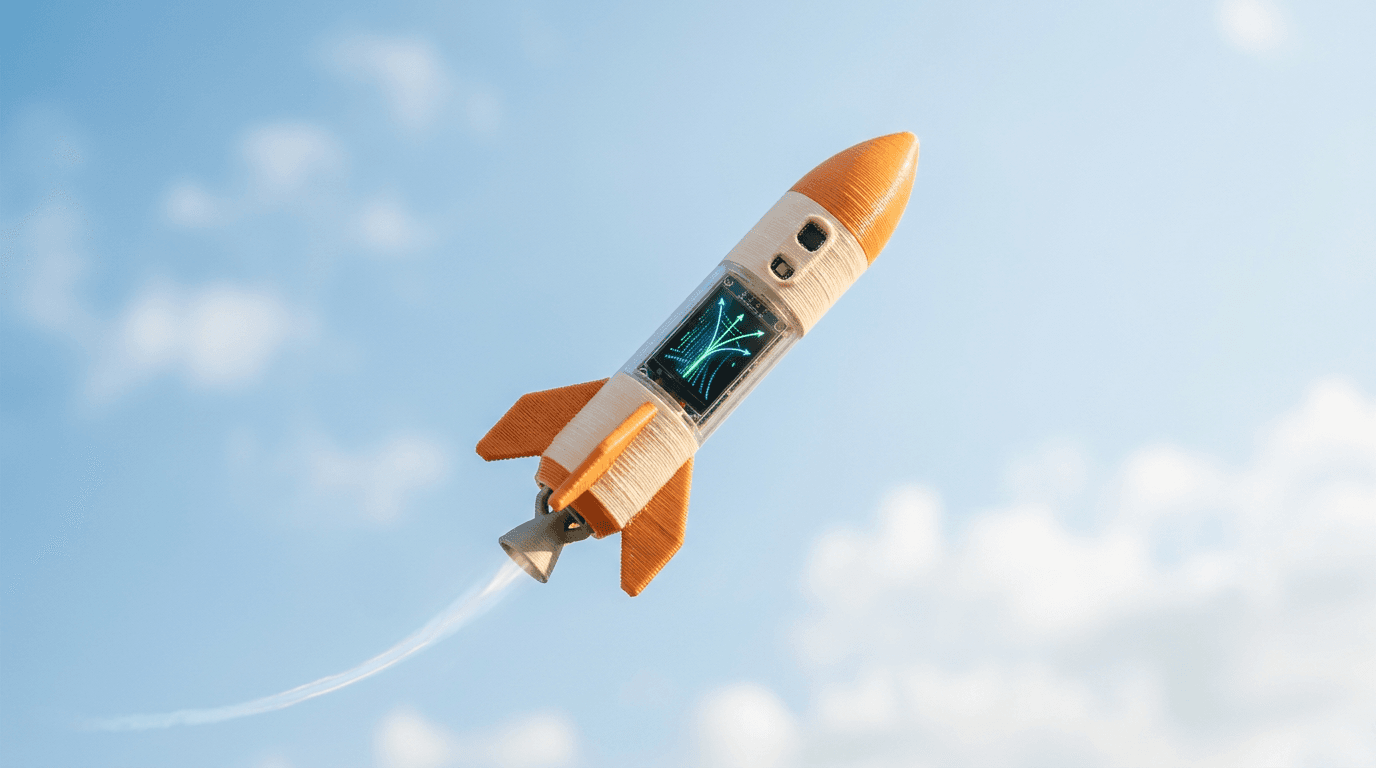
Can a $96 3D-Printed Rocket Really Perform Professional-Grade Calculations?
Learn more about apple's liquid glass interface: business strategy decoded
Aerospace engineering has traditionally been the domain of billion-dollar budgets and specialized facilities. A remarkable project now demonstrates how a $96 3D-printed rocket equipped with a $5 sensor can perform sophisticated mid-air trajectory calculations that rival professional systems. This breakthrough represents more than cost savings. It signals a fundamental shift in who can access and innovate in rocket technology.
The combination of accessible 3D printing technology and affordable microelectronics has created opportunities that were unimaginable just a decade ago. Amateur rocketeers and hobbyists now build guidance systems that would have required government-level resources in the past.
How Does a Budget Rocket Achieve Precision Guidance?
The secret lies in integrating multiple affordable technologies into a cohesive system. The rocket's flight computer processes data from an inertial measurement unit (IMU) sensor, which typically costs around $5 when purchased in small quantities. This sensor continuously monitors the rocket's orientation, acceleration, and rotational velocity across three axes.
During flight, the onboard computer compares actual trajectory data against the planned flight path. When deviations occur due to wind, thrust variations, or other factors, the system calculates corrections in real-time.
Small servo motors or thrust vector control mechanisms then adjust the rocket's orientation to bring it back on course. The 3D-printed airframe provides both structural integrity and mounting points for electronic components. Modern filaments like carbon fiber-reinforced nylon offer strength-to-weight ratios that work well for amateur rocketry applications.
The manufacturing process takes hours rather than weeks. Iterations cost dollars instead of thousands.
What Components Enable Autonomous Flight Control?
Several key components work together to enable autonomous flight control:
For a deep dive on the appalling stupidity of spotify's ai dj: a critical look, see our full guide
- IMU sensors: Combine accelerometers, gyroscopes, and sometimes magnetometers to track movement
- Microcontrollers: Arduino or ESP32 boards provide sufficient processing power for flight calculations
- Servo motors: Actuate control surfaces or gimbal-mounted engines for steering
- 3D-printed structures: Create custom airframes, fins, and component housings
- Open-source software: Flight control algorithms adapted from drone and model aircraft communities
The total component cost remains remarkably low because these parts benefit from economies of scale in the consumer electronics and maker markets. A sensor that might have cost thousands in specialized aerospace versions now sells for a few dollars in hobby-grade packages.
For a deep dive on apple tv beta software hints surface in new leak, see our full guide
What Technology Powers Real-Time Trajectory Correction?
Trajectory correction requires solving complex physics problems at high speed. The flight computer must account for current velocity, position, orientation, and external forces to predict future positions. It then determines what control inputs will minimize the deviation from the target path.
Most amateur implementations use proportional-integral-derivative (PID) control algorithms. These mathematical controllers continuously calculate an error value as the difference between desired and measured values.
The system then applies corrections proportional to current error, accumulated past error, and predicted future error. The $5 IMU sensor provides crucial data at rates exceeding 100 readings per second. Modern MEMS (micro-electromechanical systems) sensors pack sophisticated capabilities into tiny packages.
They measure forces and rotations with accuracy sufficient for stabilizing a rocket traveling hundreds of miles per hour.
How Accurate Can Budget Rocket Systems Become?
Accuracy depends on multiple factors including sensor quality, update rates, and control mechanism responsiveness. Budget systems typically achieve pointing accuracy within 5-10 degrees during powered flight. This may not match military-grade systems, but it suffices for reaching target altitudes and landing zones.
The limiting factor often becomes mechanical rather than computational. Servo motors and control surfaces must respond quickly enough to implement calculated corrections. 3D-printed components may flex under aerodynamic loads, introducing delays between commanded and actual movements.
How Is Budget Technology Democratizing Aerospace Innovation?
The significance extends beyond individual projects. When advanced capabilities become affordable, innovation accelerates across entire communities.
Students can experiment with concepts previously limited to graduate research programs. Entrepreneurs can prototype new ideas without venture capital funding. Open-source projects have created extensive libraries of flight control code, 3D-printable designs, and documentation.
Newcomers can build upon proven foundations rather than starting from scratch. This collaborative approach mirrors software development practices that transformed the tech industry. Educational institutions increasingly incorporate these technologies into STEM curricula.
Students gain hands-on experience with real engineering challenges, from structural design to embedded programming. The low cost removes barriers that prevented many schools from offering practical aerospace projects.
What Are the Practical Applications of Budget Rockets?
Beyond hobbyist satisfaction, these technologies enable practical applications:
- Research platforms: Universities test new control algorithms and sensor fusion techniques
- Education tools: Students learn aerospace principles through hands-on building
- Prototype development: Companies validate concepts before investing in expensive materials
- Competition vehicles: Rocketry competitions increasingly feature autonomous guidance challenges
Some teams have demonstrated landing rockets vertically using similar budget components. This mimics SpaceX's Falcon 9 boosters but at a scale accessible to dedicated amateurs.
The technical challenges remain substantial, but the financial barriers have largely disappeared.
What Safety and Regulatory Issues Apply to DIY Rockets?
Affordable technology doesn't eliminate the need for responsible practices. Rockets, even small ones, pose safety risks that require careful management. Most countries regulate amateur rocketry through aviation authorities that set altitude limits, launch site requirements, and certification processes.
The addition of active guidance systems introduces new considerations. Autonomous vehicles that can change course mid-flight require additional safety measures.
Many hobbyists implement failsafe systems that terminate flight if the rocket deviates too far from safe parameters. Responsible builders also consider where their rockets might land. GPS modules, which cost around $20, enable tracking and recovery.
Some advanced systems include parachute deployment algorithms that optimize landing locations based on wind conditions and ground features.
What Does the Future Hold for Budget Aerospace Technology?
Current trends suggest capabilities will continue improving while costs decrease. Sensor manufacturers regularly release more accurate and capable units at similar price points. 3D printing technology advances toward stronger materials and faster production.
Machine learning algorithms may soon run on affordable microcontrollers, enabling more sophisticated flight behaviors. Rockets could learn optimal trajectories through simulation before flight, then adapt to actual conditions in real-time.
Computer vision systems using cheap cameras might enable precision landing on designated targets. The gap between amateur and professional capabilities continues narrowing in specific areas. While budget systems won't match military-grade precision or reliability, they increasingly suffice for many applications.
This democratization of technology creates opportunities for innovation from unexpected sources.
Why Does the $96 Rocket Matter for Aerospace Innovation?
The $96 3D-printed rocket with trajectory correction represents more than an impressive technical achievement. It demonstrates how converging technologies create new possibilities for makers, students, and entrepreneurs.
Affordable sensors, accessible manufacturing, and open-source software combine to bring aerospace capabilities within reach of ordinary enthusiasts. This accessibility fosters innovation by allowing rapid experimentation and iteration. Ideas that might have remained theoretical can now be tested in actual flight.
Continue learning: Next, explore rack-mount hydroponics: smart vertical farming tech
The next generation of aerospace engineers gains practical experience that complements classroom learning. As components improve and knowledge spreads, we can expect even more impressive achievements from the amateur rocketry community. The combination of low costs and high capabilities ensures that innovation will continue accelerating, potentially leading to breakthroughs that benefit the broader aerospace industry.
Related Articles

Transforming Gaza: From Conflict Zone to Tech Hub
A leaked plan from the Trump administration reveals a bold strategy to turn Gaza into a thriving high-tech hub. Discover the potential.
Sep 3, 2025

AI's Role in Unveiling ICE Officers' Identities
AI unmasking ICE officers underscores a shift towards transparent law enforcement, raising questions about privacy and ethics in the digital age.
Sep 2, 2025

Gaza's Tech Revolution: Trump's Bold High-Tech Vision
A leaked plan from the Trump administration unveils a vision to make Gaza a high-tech hub, focusing on AI, cybersecurity, and digital innovation.
Sep 3, 2025
Comments
Loading comments...